And vice versa. And even if you have come to prefer your vice versa, you still have to take time out of your busy round of orgies to deal with the painting on your model airplane, structure, or car. And inevitably you are going to need to mask something off for some reason.
Brace yourself – it is as easy as falling off a log – onto a pile of sharp boulders set at cruel angles. You’ll know you’re having a good time when you snap your collar-bone.
But seriously, the business of masking off one part of a model to paint another is something that is very common. We have all progressed past the days of shakily hand-painting everything and just accepting the drips, runs, mountainous edges, and other horrors of the early days. We may have advanced to acrylic paints from enamels or to enamels from acrylic, but it’s pretty certain that we’ll be spraying something sometime – even if it is just coffee out our nose when the cat jumps on the modelling table.
Few of us can spray freehand, other than in pub restrooms. We try to do a good camouflage pattern with just the airbrush and a steady eye and end up spraying the whole model one solid colour and making an excuse for it. In truth, unless we are making Luftwaffe or IJAF upper surfaces, any variations really need to be masked. Commercial paint schemes in particular may need to be extremely sharp, symmetrical and detailed. You must prepare yourself for a ratio of about 20:1 in the time you spend masking compared to that spent actually spraying.
What actually is your workflow going to be – that varies with each sort of model and modeller. And very much with the sort of material you are going to spray. But there are a few general principles:
a. Work from smaller areas to bigger ones if you can. By this I mean, paint a stripe or trim part area, mask that off, and then lay the major colour over that. It’s a lot easier than trying to mask off the entire model for one tiny part. Anyway, you are also wise to paint that part as a subassembly well away from the major work.
b. Mask less complex parts if you can. Masking materials can be made to bend and stick to many surfaces, but eventually there will be something just too topographically difficult to retain the tape, paper, or other material and you risk exposing it.
c. Mask things that can actually take a mask – some plastics or woods are greasy, rough, or pliable, and it seems that very little will stick to them. They will probably be a pain to glue or fasten as well, and you may wonder why you or the model kit maker decided to use them in the first place. Bad decisions are part of the hobby…
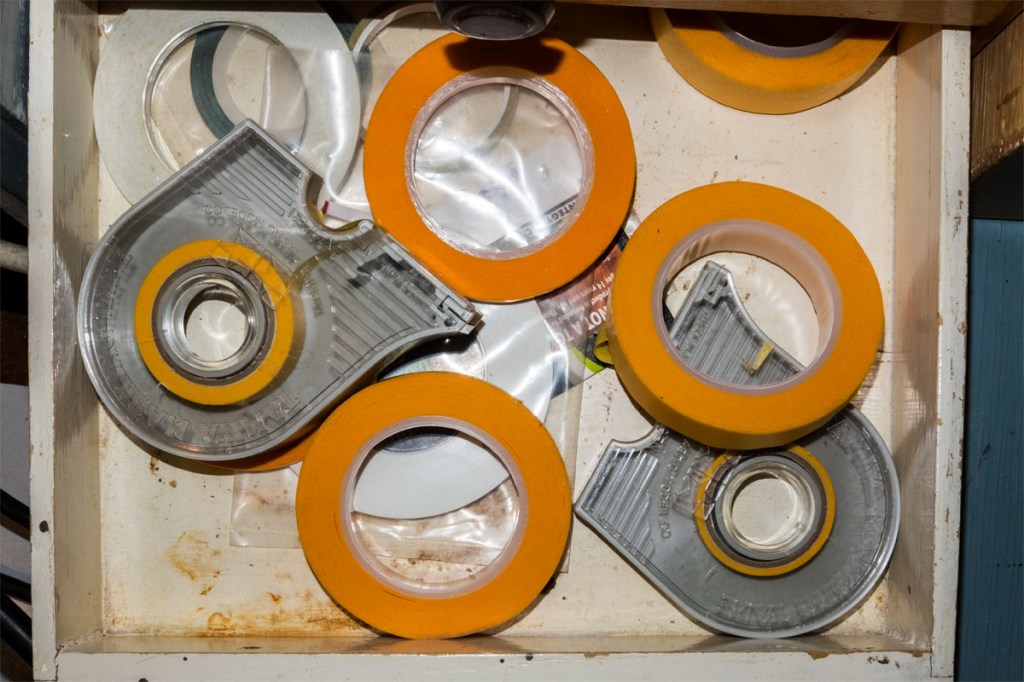
d. Get a variety of tapes, papers, and masking solutions for your workshop – you can make some jobs much easier if you do not try to use tapes that are too wide. Start narrow, and work wider from there. If the cost of multiple tapes is frightening, consider getting wide roll and slicing it up yourself.
e. Use paper shapes, wadded tissues, wetted-down paper towels, blobs of Blu or Yellow Tac, or anything else that you have to hand to occlude holes and gaps in the masking job. You can tape newspapers to bigger models just like car painters tape them to full-size vehicles.
f. Test all masking tapes to see if they will stick well enough and then release easily enough. Really do this on a spare wing or broken fuselage. Give it a coat of your standard paint and then try all the tapes you have on it to see if they prevent paint creep. Some of the stuff from the DIY hardware store is brilliant and some of it is quite ineffective.
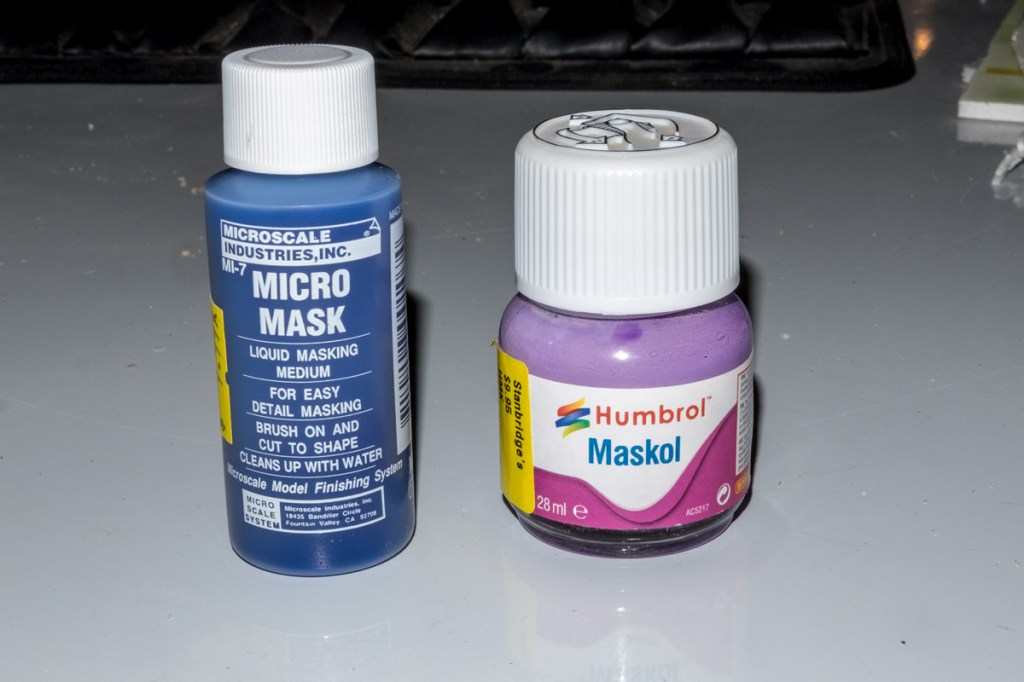
g. Try masking clear windows with PVA glue and then peeling it later with a wooden toothpick. Surprisingly effective! And you needn’t be in a rush with your paint coats so that you get it off before it attacks the substrate – Humbrol Maskol has a three-day limit as a mask. It’s good, but plan to use it when you’ll be done in time.
h. Finally – you cannot mask everything. Accept the fact that you’re gonna have to brush something by hand at some stage of every model and just learn to brace and stroke the brush steadily.
 The Little World
Leave a comment