
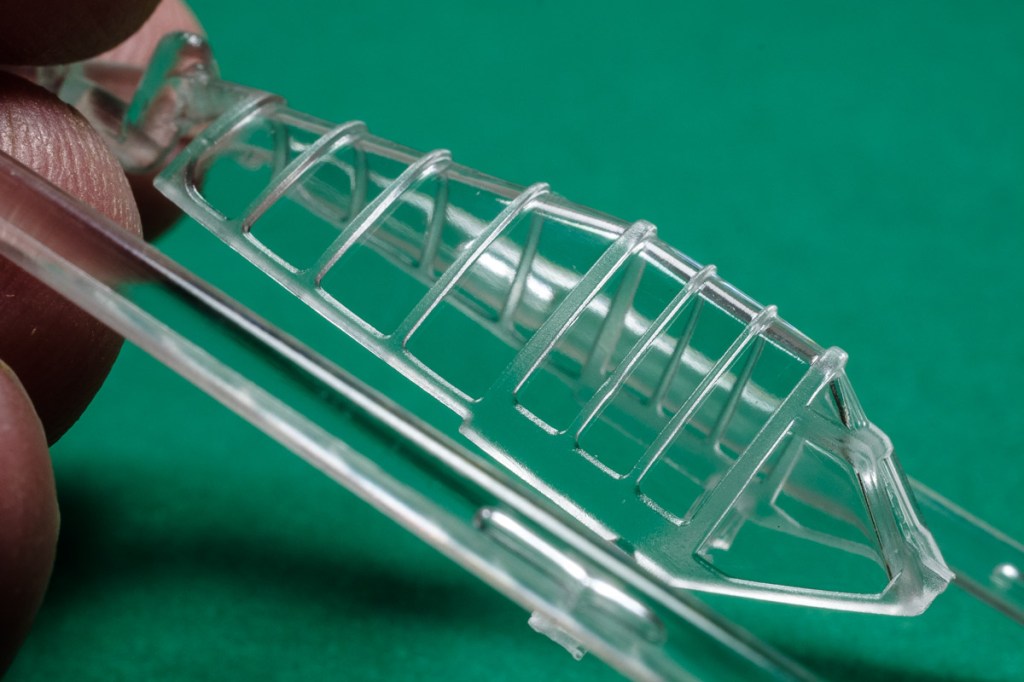
Woah! That’s a revelation!
I’ve been learning the business of masking and painting clear canopies and turrets for the 1:72 aircraft over the past couple of months. It has not been an easy process, as I have discovered just how un-detailed parts can be in some kits.
If you combine this with the propensity of some English aircraft makers of the 1930’s and early 40’s to glaze their designs with as many small panels as they could…you can see my frustrations. I think some of them thought they were working on stained glass windows…It was only later that they seemed to realise that they could blow perspex* sheet into ever-larger bubbles and provide good vision – and easy modelling – for all.
Well, the model manufacturing firms are bound to follow suit no matter what the 1:1 people did, and they have the problem of deciding how much detail to incorporate. Again I can apply the SIN ( Stein Index Number ) to the clear plastic parts – think of you average current Airfix 1:72 aircraft kit as having a canopy that scores 50 SIN. It is reasonably clear, of a correct shape, and with traceable frame lines.
The Special Hobby 1:72 pilot’s compartment cover part for the Northrop Delta 1D scored 40 SIN – less definition on the frame lines but still enough to clearly mask.
The Special Hobby 1:72 pilot’s and navigator’s compartment cover part for the Anson Mk1 scored 30 SIN – it still fitted but the frame lines were very faint.
In contrast to these, the canopy for the Hobby Boss Brewster Buffalo gets an 80 SIN. Superb definition of the frame lines for such a small model. I look forward to masking and painting it.
* Plexiglass in North America.
 The Little World
Leave a comment