I’ve been watching YouTube videos lately to see what other people do to build and paint model kits. In some instances I’ve been amazed at the reckless candour of the broadcasters. If I were a tort lawyer I would be rubbing my hands together with anticipatory glee.
You see, poor model reviews passed between consenting adults in the privacy of their own homes…after dark with newspapers spread over the floor…is all very well – very little will ever be seen or said. And there is really nothing for a legal eagle to swoop on. But pasting major manufacturers over the internet in full colour is another thing. You cannot be too careful these days – only the American president and long-dead people are a safe topic for censure. And even then, Bluebeard and Ashurbanipal probably have supporters.
So I am going to go the other way – I am going to praise famous people…well famous products anyway. And I’m going to do it upon the basis that I have paid for the stuff, tried it out, and achieved success. And still have enough fingers left to type with…
The famous maker today is Humbrol – producers of paint and adhesive products for the modeller. Doyens of the tiny tin can. And makers of some very entertaining YouTube clips.
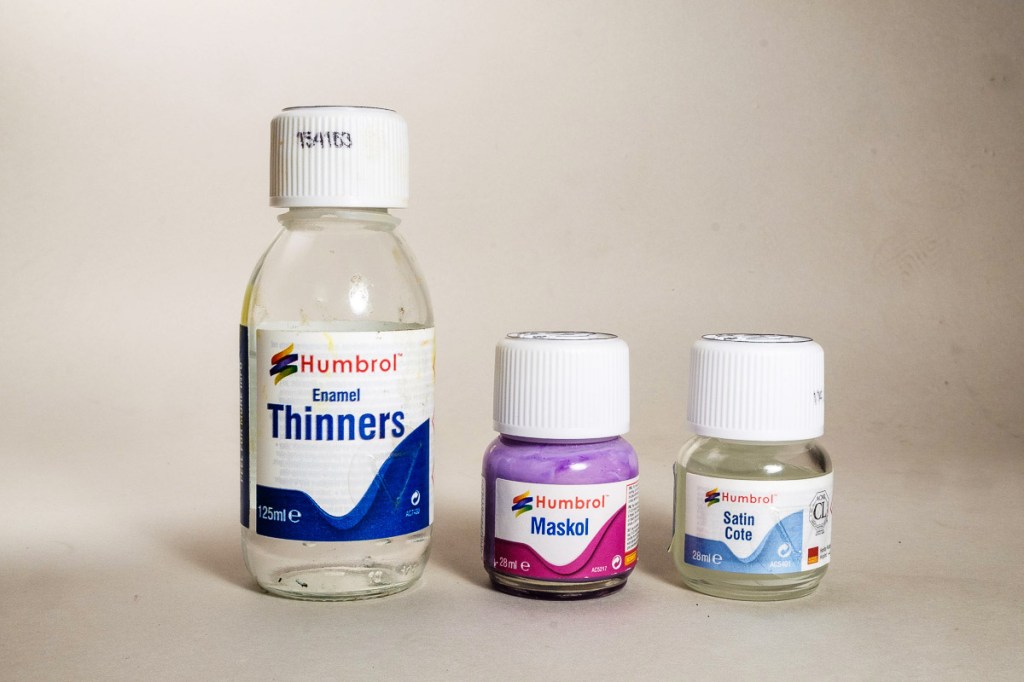
A. Humbrol Maskol.
This is a vile-smelling rubber compound that you paint on to areas of a model before spray painting to protect them from the paint. When Maskol dries it snugs down to the surface and resists enamel or acrylic paint. It might be equally applicable with a lacquer but I haven’t tried that yet.
My initial impressions of it were poor – I tried it as a mask for the respraying of a die-cast car roof, and it was awfully fiddly to put into the small areas of the roof trim. When I went to remove it , it seemed to get stuck in cracks. I shelved the bottle.
Recently, however, I needed to mask off some aircraft canopies that were already stuck down on pre-made models. I shook the bottle, grabbed a larger brush, and painted away – the stuff flowed well, was easy to steer round the edges of the canopy, and set within a half hour. Then I sprayed and peeled it back a day later. Perfect result. Could not have asked for a better demarkation line.
Lessons learned:
Use a larger brush.
Use a good deal of the liquid and steer it around.
Don’t leave it to set on the model for longer than a couple of days.
Clean the brush in water immediately after you have completed the last of the masking – it cleans off beautifully if you are fast.
The next trial for this will be for camouflage. I’ve tried a number of systems to demarcate the colours and I may have been getting too complex for my own good. Maskol might be the exact thing needed.
Still stinky, but you can breathe through your ears.
B. Humbrol Satin Cote
One assumes this is the famous drink of the Cote de Humbrol…?
No seriously, guys. Humbrol Satin Coat is just as good a name and doesn’t cause our grammar glands to pucker. But enough of that – this is the final coat that I am going to employ for most model aircraft in the future – it has a semi-sheen to it that seems to duplicate what I see in real life and in photographs of aircraft that I’ve not seen. It is definitely a better choice for my tastes than the acrylic matte that I tried initially – that just became a dusty mess.
It cuts with the Humbrol Enamel Thinner in the large bottle – I try to get a 50:50 ratio – and it comes out smoothly from my El Cheapo 0.50 airgun. The drying time seems to be no more than a half hour and it makes a decal look as if it was painted on. So far it has not lifted any of them and does not seem to have a bad reaction to Tamiya or Mr. Hobby colour coats or plain plastic surfaces.
I have eschewed the use of the acrylic satin coat that I tried before – and not before time – I looked into the bottle and found clumps and lumps that would have been the death of the airbrush nozzle.
C. Humbrol Enamel Thinner.
I see on YouTube that some people think that they can get as good a thinner by buying white spirit or other hardware store liquids. Perhaps they can. I am not going to dispute this. I am also not going to risk the final finish on my models by decanting Russian rocket fuel into a beaker and trying it out.
One YouTuber complained at the glass bottles this came in – saying that when he knocked things over glass always shattered. I think I have a solution to this and it is to paint carefully and not knock the bottles over. Must give this a try.
This is greasier-feeling than the methylated spirits I run through the acrylic gun, but seems to clean up superbly. I still use turpentine fo the final gun clean, but this is what I’ll reserve for the spray coats.
 The Little World
Leave a comment