

Or ” When Does An Airplane Start To Live? ‘.
Okay. You’ve done the interior painting. You’ve stuck on the instrument decals. You’ve decided whether or not you’ll spend an extra month trying to put in photoetched seatbelts, pilot’s clipboards, and spare chewing gum dispenser ( US aircraft only).* Everything that could be sub-assembled and painted in preparation is done. Now you actually have to start making an airplane.
Will the manufacturer of the kit allow you to do so? I ask that because a few of them incorporate so many odd assembly interlocks in their workflow that you need to be very cagey about what sticks where and when. And some makers have made bad kits that will not glue together anyway. You are far better making them as a cutaway or better still – a throwaway.
So far my score has been good – even the horrid Special Hobby Anson Mk I eventually closed up well enough to putty and paint. And the new Nakajima ‘ Kate ‘ is sitting in the workshop quietly setting with the aid of masking tape strips and some old Xacto clamps. Its surfaces mate but there is a little tension involved in the wing/fuselage interface that needed the clamps. Not enough to be in danger of a ” Sproing ” at a later date, but enough to take note of.
I took the opportunity to jig up the structure and cement on the horizontal stabilisers at the same time – because as soon as you have a wing, tail, and fuselage, you have a live airplane. You can start to feather it, power it, give it legs and feet, and fill and sand to the extent that your patience will allow because now it is your bird – not a box of bits.
Note that so far this build has taught me several new things:
a. Lower the pressure on the airbrush – I used to shoot at 25 – 30 on the dial. Now I shoot at 18. And I screw the limiter knob at the back of the brush in further to reduce the amount of paint that comes out in any one pass.
b. Clean the needle every so often – the paint dries on it and restricts the flow. A gentle wipe is all you need.
c. Don’t mix too much paint. My eye is getting better for the amount that is needed for an interior or an external coat. There is much less wastage.
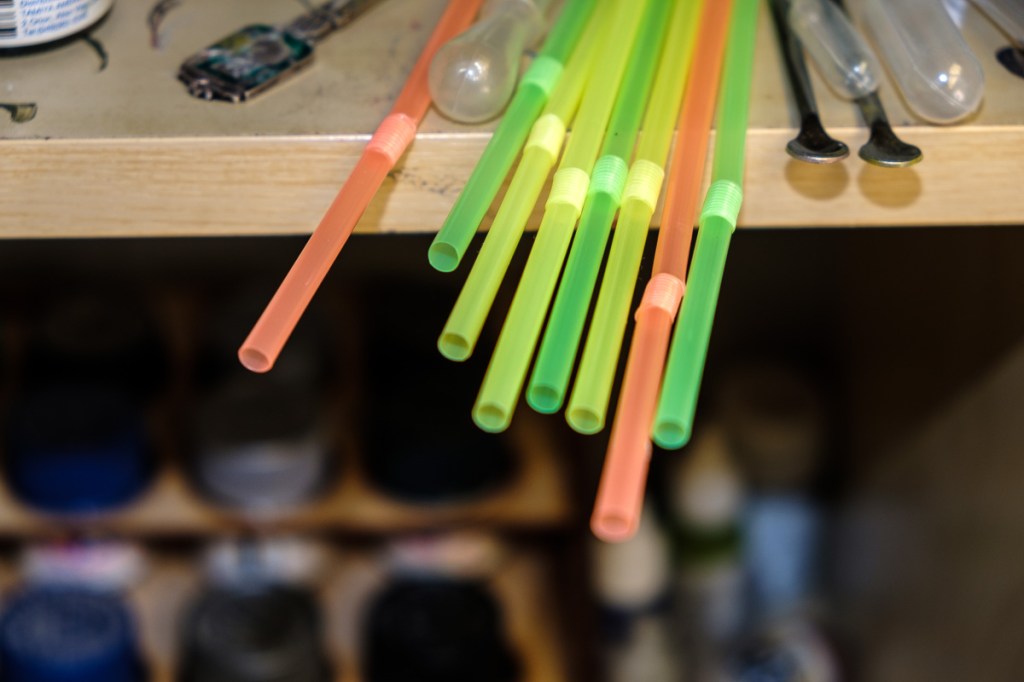
d. Pipette out the paint from the bottle with a soda straw, use the straw to mix with the thinners, then cut the contaminated end of the straw and use it another time. The Tamiya lids are now coming off the bottles much more easily.
e. Google up real museum examples of whatever you’re modelling – don’t depend on the manufacturer’s colour recommendations.
* Japanese aircraft had a special compartment for origami paper. I’ve left it off…
 The Little World
Leave a comment