
I rarely go downtown these days unless it is to haunt the bookstore or check up on the branch of the camera shop I used to work for. The rest of the shops are filled with wonderful things that I don’t want and the streets are filled with people I wish to avoid. But there are times, and on one of these occasions I visited one of the few remaining hobby shops in the central business district.
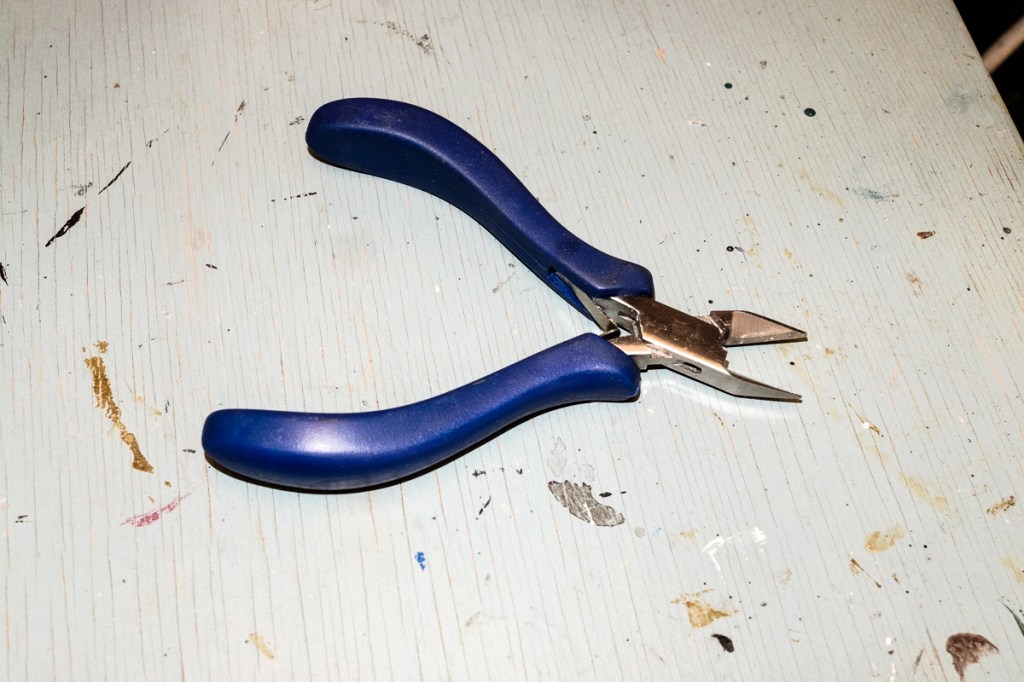
TACTICS supplies the gamers and figure collectors – it occupies an enviably grotty basement under a historic arcade – very reminiscent of Perth hobby shops of the 1960’s. I’m not a wargamer but the variety of kits and die-casts looks to be worth checking on every six months or so. My last visit yielded a 1:76 Bofors gun which is emplaced at my model airfield. It also yielded the blue-handled tool you see in the heading image.
Side cutters – modellers sidecutters – with a strong leverage and precision blades. I had never owned a pair and I can’t really think why I decided to buy them, but I’ve congratulated myself ever since.
When I was a kid building plastic models I was allowed the use of a sharp knife pretty early on. It was either a Swann-Morten scalpel or an Exacto knife with a medium handle. I guess my folks decided that if I was going to learn not to cut myself I had better be given a chance to cut myself. I found out how to do that with a sharp knife and well as a dull one, and progressed past the red finger stage quickly. I learned to scrape and to smooth with the blade, and have no use now for specialised tools to reduce seam lines – I use a curved Exacto blade that must be about 50 years old and I know what to expect from it.
The thing that always bugged me, though, was the business of cutting parts off sprue formers. I was either going to have to repeatedly stroke the sprue line or apply considerable force and that made me nervous – particularly with the Swann-Morten. I often gouged parts and had to fill and sand them. But no more – those side-cutters are the answer.
I now separate all the heavy parts from the sprue with the cutter – flat side of the blades nearest the part. I leave some excess to be cut or sanded off but there is no distortion of the plastic in the part like before. I still cut off extremely small parts but I’m getting bolder – I will look at the Burfitt stand at the next model railway exhibition to see if they make equally good smaller cutters.

The final picture is the same cutters allied with the other not-so-secret Little Workshop weapon – the Excel knife. This is the same as the historic Exacto, I suppose. The real discovery for me was how much more control I have with this handle than I ever did with the middle-sized aluminium shaft. The thin shaft one is the choice for tiny cutting round canopies but this big one does everything else. I spend money on fresh blades more than ever I did before – surgery work taught me that was the safest and most efficient policy.
ADDENDUM: Since writing this post, I have bought a smaller pair of side cutters – one of the cheap Korean brands – and find them even better with small parts. Such a simple discovery, but so pleasing.
 The Little World
Leave a comment