
You know what a goodbad idea is? it’s a brilliant thought that you have had, carried out, and been sorry for. The opposite is a badgood idea…You’ve done something dodgy that has turned out well. The ratio of the two in some fields is 4:1…in politics 40:1.
The best thing about the goodbad is that it can sometimes be reversible if no-one finds out. Of course the worst thing about the badgood is that it is also reversible if someone looks closely at what you did. Always be prepared to answer questions but remember that you need no always tell the truth – especially if you are the closest one to the door.
So what went wrong with the Blenheim Mk I?
a. I decided that I would glue the propellers on it with white Weldbond glue. That was all very well, as there was enough of a spigot to put the prop on…but I didn’t put them on all that straight. It was one of those things you saw when you looked at the aircraft in plan form. Photographed from the right angle, nothing seemed amiss.
Fortunately this goodbad was possible to undo. I wrapped the glue joint in string and wet it overnight – that softened and released it – and then I put it back together with a plastic cement.

I do not decry white glue, as you’ll have read in an earlier column. It serves the wood/paper/foam materials very well. It reinforces some plastic joins. But it sets slower and needs more supervision.
b. When I had finished the camouflage colouration I decided to do and overspray with a semi-matte Tamiya varnish. It went on looking good, but dried duller than I expected with some white blobs and dots scattered through it. I suspect I had not stirred it enough…but my experience later with the Humbrol Satin tells me that it is a better material in my hands. Okay, lesson learned. I’m shooting Humbrol varnishes now over Tamiya and Creos acrylics and happy with the museum finish.
That’s the goodbad – fortunately there were a couple of badgoods. One of them called forth a great deal of anguish as I did it – the canopy masking. I couldn’t belive the amount of dicky little panels of perspex the English put on the front of this plane. Were they contracting it to out-of-work cathedral glaziers? Are these the same airplane designers that came up with the magnificent Spitfire Malcolm hood? Note: The later marks of the Blenheim with the longer noses had equally weird framing and glazing. I think they drank at lunchtime in the Bristol works…
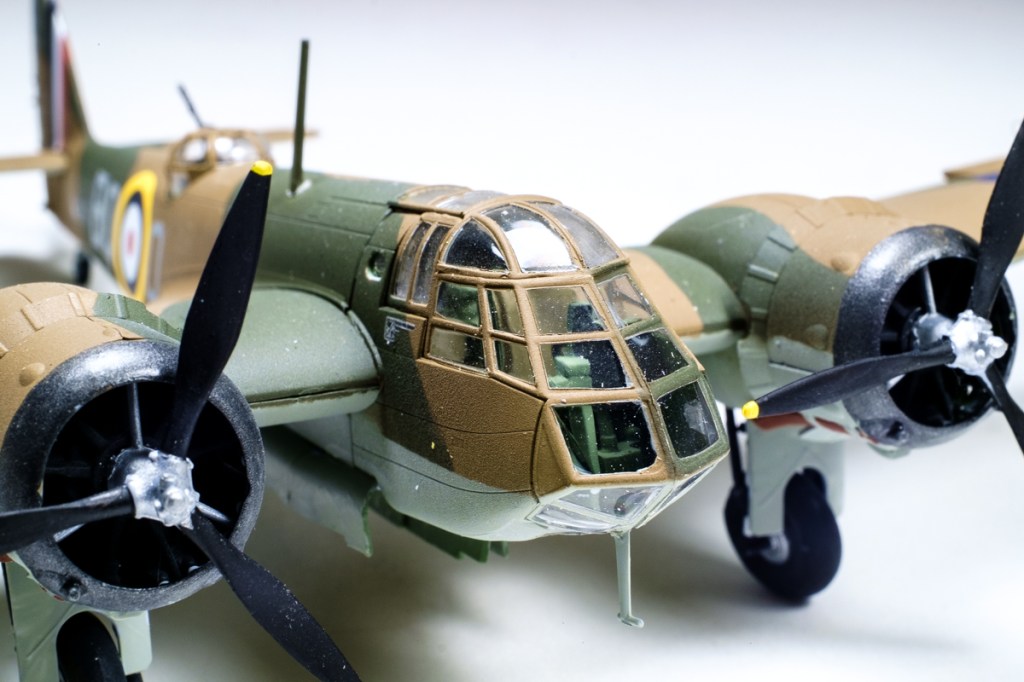
As you can tell, I hated it, but when I peeled the tape off the clear parts at the end of the line I was delighted with the way it had captured that ” cigarette card ” look.
The other badgood was the changeover for the underside from a closed belly and gunpack to opened doors with a bomb load. There were original rigging diagrams on Google for the doors and racks and the Airfix parts were so obviously right that it was easy to sort out the look.
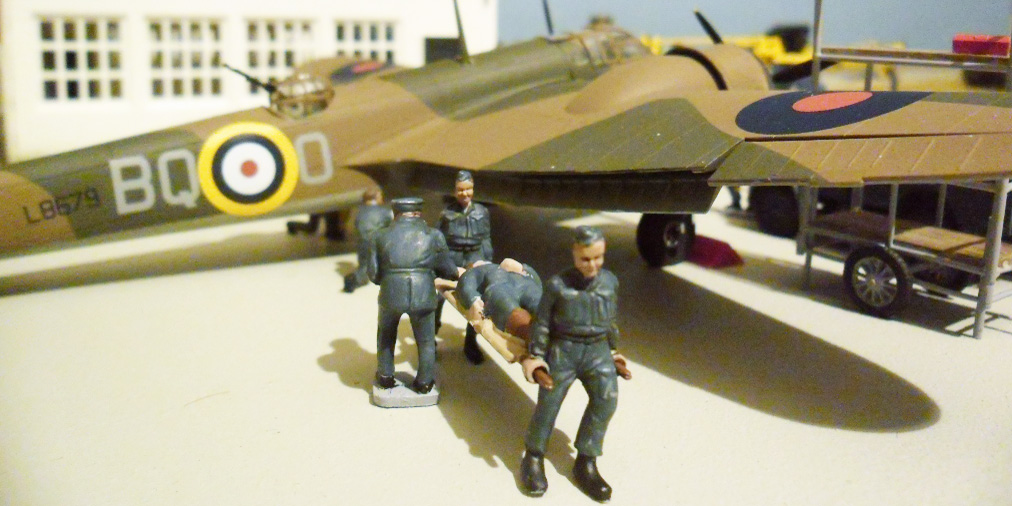
You might also put Airfix’s habit of including crew members into either category – I think they are a goodgood idea myself. If I do not want to include them, I can save them for another plane – but I do like having the option. One day I will be a good little figure painter – a long time in the future – but for now the crew are human enough for me.
Also goodgood is the under-load tyre flat that Airfix mould under these new kits. I realise I could do this with a hot knife, but with my luck I’d melt the tyre.
I’ll leave the rest of the model club to debate raised rivets, sunken panel lines, and windows that are moulded exactly to the size of the opening in the fuselage. My mate lost one during a build and it’s going to be in that plane from now on like King Tut in a pyramid.
My only badbad concerns the tail wheels and main gear struts that are being increasingly accurate and spindly. I reinforce them where I can unseen, and in the cases where I can see the braces I wink at the sin. I would welcome metal struts and/or better fixture points. It is one thing that gives me cause for pause about building 1:72 WWI aircraft…
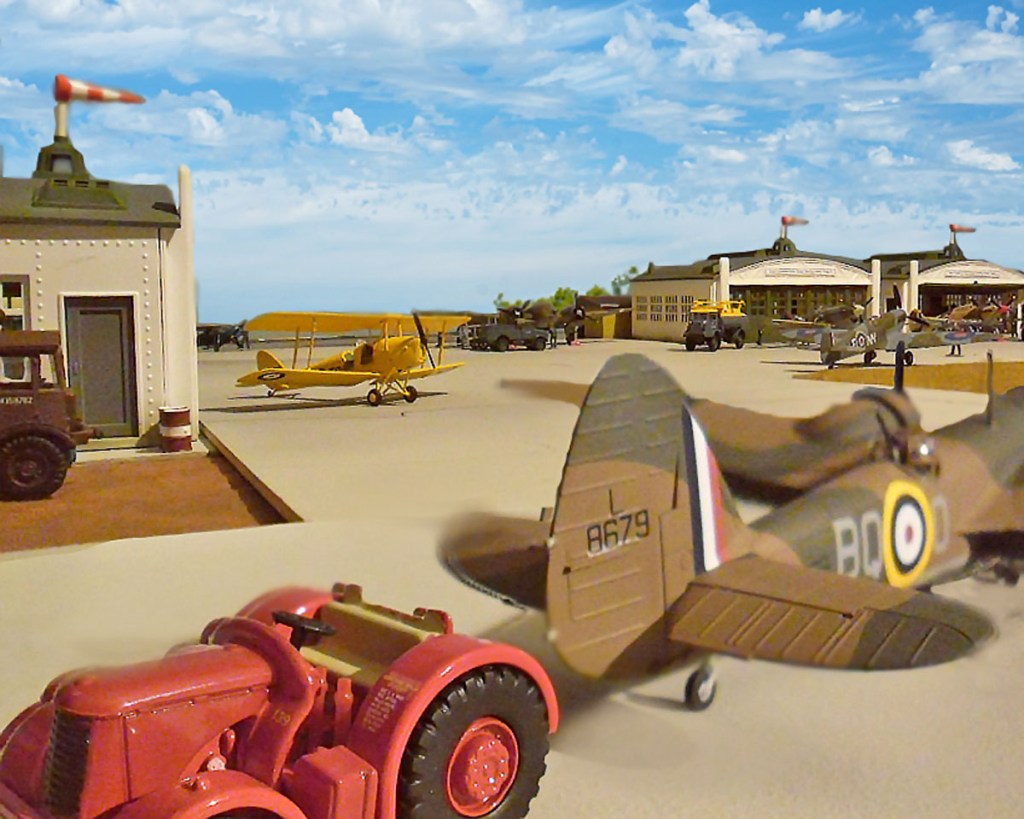
Note: The airfield pictures were done by my pupil Sean in the Little Studio.
 The Little World
Leave a comment