
Part Six of the DH Mosquito Mk II saga showed the dull and sad paint job that I ended up with after failing to think properly about what I was doing – I sprayed a matting acrylic too heavily and cured it under too high a temperature. I regarded the result as a failure on an otherwise wonderful model.
Well, it hasn’t been my only failure of a final finish, and I decided that if I was going to avoid more, I would have to start doing things in a scientific or at least workmanlike manner. Otherwise all that was going to be produced was the same disappointment. SO…
a. What was I unhappy about? The scrappy, patchy, and dull nature of the final coat. The dirty nature of the topcoat on the previous Hawker Hurricane as well.
b. What did I want as an alternative? A smooth final surface and true paint tones.
c. What caused the dissatisfaction? The matte finish whitening out the underlying paint. Particles getting trapped in the coat.
d. How could I make the next model different to attain satisfaction? Find a system of coating a clean surface to preserve what has been done before. As matte coating seems problematical, would satin or gloss look better?
I solved the problem of the dirt on the model surface by realising that I had dusted it down with a brush that contained…dust and particles – it had been open to the shop while other construction was going on and dust had settled into it. So I vacuumed the place thoroughly, then washed all the brushes and stored them in a sealed box.
The final wipedown before each coat of spray paint or finish in the future will be done with a microfibre tack rag and the model examined under a strong cross light. The tack rag may also benefit from being ever-so-slightly damp.
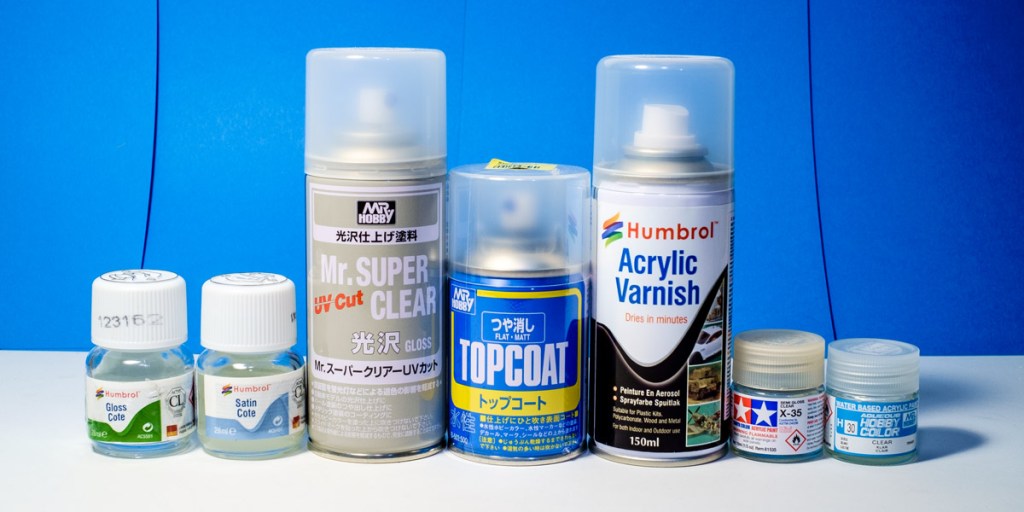
But it was the question of that final coat that puzzled me. There are any number of alternatives sitting in the hobby shop paint aisle – and I am aware that some of them are incompatible with other products. The lacquer-based things promising to harm the enamels or acrylics…But sometimes the Japanese writing does not explain to an English reader exactly what’s in that container. I determined to get one of each and make my own experiments. A week of science, or at least a pile of sample tablets done with each system. It would be fun if I whistled while I worked…or at least cursed.
After all, Salvarsan was number 606 in the messy experiments by Ehrlich, and if he could stand to look at that many lesions, so can I.
 The Little World
Leave a comment