
And paint mules. A fine dinner combination, but you have to be trained up to the taste.
Today has been another day spent in the Lawrence Liverwurst labs, experimenting with finishing materials. I have seen intriguing advertisements for different clear coats and decided to see if they were indeed the El Dorado of painting. I guess I am seeking the Fountain Of YouTube…
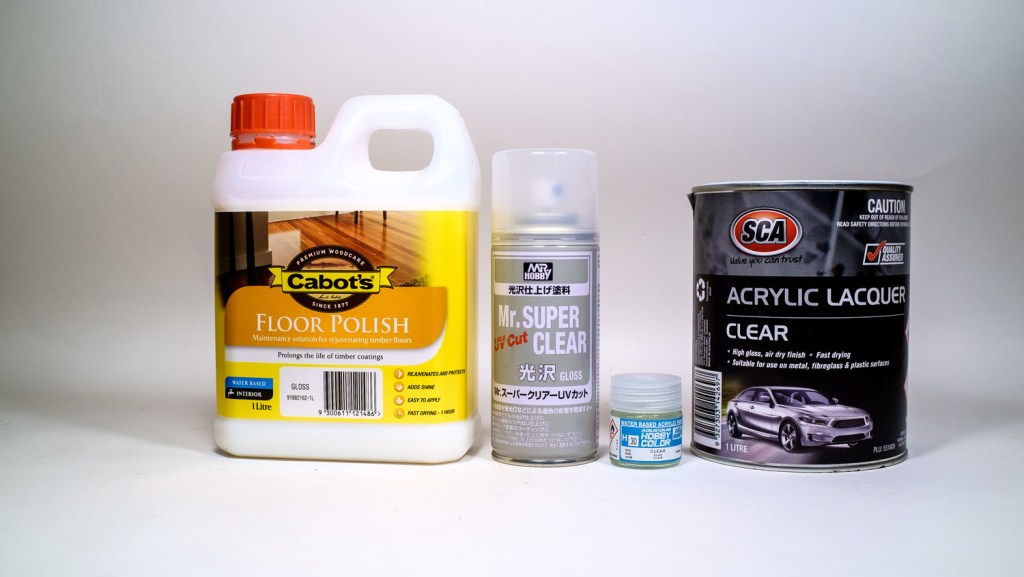
The materials rounded up for the experiment were:
a. A proprietary acrylic floor polish made by Cabot. From Bunnings, it is water-based, cloudy, but reasonably inexpensive. It is thin and can be sprayed directly from the jug without diluting. You can’t get the Future and Kleer that are spoken about in the modelling press readily here in Australia, so this might be a substitute.
b. A clear acrylic topcoat intended for automotive use. Available from any Supercheap Auto Warehouse, it comes in a litre can with attendant lacquer thinner.
c. Mr Hobby UV Cut Topcoat – this is solvent based in a rattle can and is expensive.
d. Mr Hobby Aqueous Clear Topcoat in the small jars. Available, but frequently out of stock…
I prepared paint mule chips but this time I took the advice of Phil Flory and used styrene sheet. It mimics the plastic surface of a model kit better than an MDF chip. It meant I could test the solvent safety of the Supercheap lacquer thinner.
Now you might wonder at me going out of my way to search for things that can be duplicated at the hobby shop. It is the cost and availability of the stuff that concerns me. I won’t be grinding my own pigments and making my own paints, but I do realise that there are a lot of other things that go into a model. Plus I need to know or I won’t sleep at night…
There is also the factor of the magazines, YouTube, other modellers, and folklore to draw me further down the rabbit hole of painting. If all the US builders advise you to use floor polish to seal the surface of your model, you naturally assume that this is the only way to do it. Of course if, you speak Japanese and follow Japanese YouTube modellers, you find they use proprietary sprays to do this. I’ll bet there is someone in Russia or Ukraina who uses boiled birch sap for the same thing…
Note for the experimental amongst the readership: If you are going to do this sort of stuff go hard or go home – gather as many alternatives as you can afford and don’t be afraid to mix and match the stuff. You’ll find that there are things that just do not work, but you only have to find this out once on a 2 x 3 plastic chip that costs you nothing and then you know to avoid that error in the future. Everything you find out is useful – positive or negative.
It also pays to be suspicious about the claims of the makers. Test everything yourself and you’ll not be horrified when you find out you have been lied to. I have my doubts about that Supercheap Auto thinner so I brushed some onto a scrap of bare styrene sheet. Sure enough, it was chemically hot enough to melt the plastic. In contrast to this , Mr. Hobby Levelling Thinner 400 and Tamiya Lacquer Thinner can go on bare plastic without eating into it. So the Supercheap thinner is going to be good for cleaning airbrushes and paint pots, but not for styrene models.
Actually I suspected this, so all the experimental paint mule chips were prepped with Tamiya Fine Undercoat. This could have also been done with Mr. Hobby Surfacer 1000 just as successfully. Once the styrene chips were sealed it was all good to go.
 The Little World
Leave a comment