
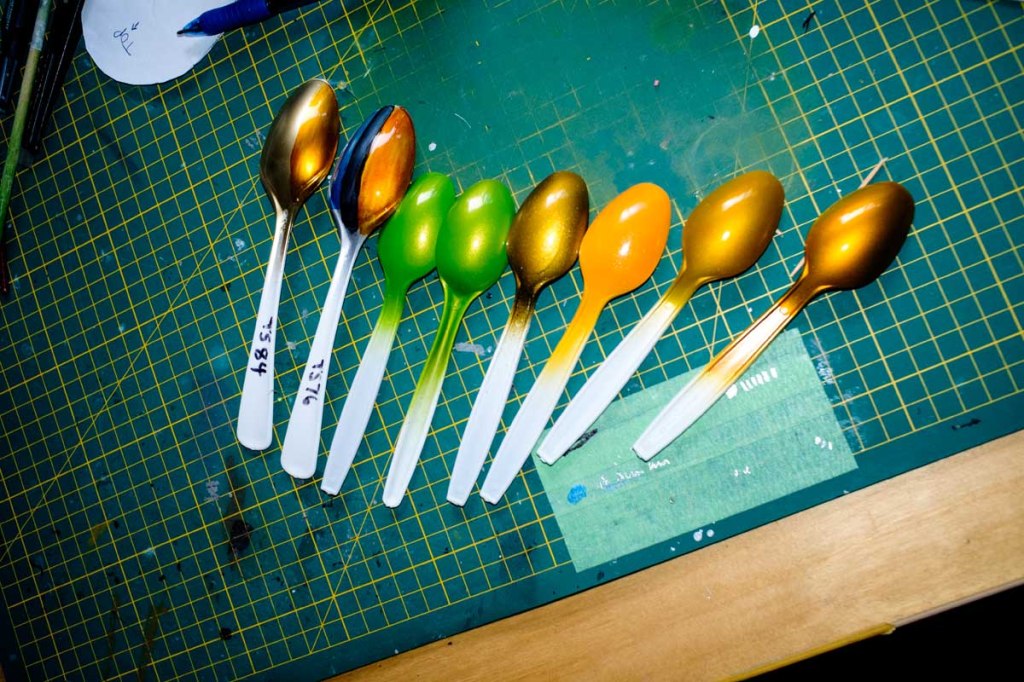
To spray or brush. Whether ’tis nobler to dilute the paint and shoot it onto the tiny row of parts in a minute and then spend 5 minutes and 10ml of cleaner getting the airbrush clean again, or spend ten minutes brush painting the little suckers…and the next week trying to ignore the brush marks.
No contest with the big job – the wing or fuselage or car body that has to be perfect. No matter how glib Humbrol are with their videos on YouTube, pushing a brush over a large surface is going to give you more texture than ever you want – whether it is brush streaks, trapped bubbles, hairs or pigment lumps. You know that you will be sending hours cutting it back after it all sets…
This is the time you reach for the rattle can or the airbrush and take your time to thin, spray, and cure the thing. You’ve ever-so-much better a chance to get a smooth surface. You’ll pay more for the gear and the paint, but it will be worth it.
But the little stuff? Two wheels? A couple of guns or landing gear struts? Be sensible – brush them. The small areas support the paint better and the streaks are negligible.
However, there is a third answer that you may not have considered. It is something that commercial production depends on for mass painting on an economical basis. Dipping.
Again, imagine a tedious painting task – a row of tiny airliner seats, or track links, or simple detail parts. Or small, repetitive tasks that would take just forever. Try the following:
a. Select a paint that is a bit thicker than the average model acrylic, but a little thinner than the lacquer-based ones. Or adjust the consistency of your favourite brew until it falls into this middle ground. You’re not looking for airbrush dilution at all, but you need a bit more flow .
b. Measure the longest dimension of your part. Select a plastic tube that is deep enough to take this if it is inserted from the open end.
c. Fill the tube to about 1/2 to 3/4 with that thinned paint.
d. Grasp the part with an alligator grip paint handle – the ones that you get in a packet at the hobby shop. Pick it up at one end of the part.
e. Slowly dip the part down into the paint until it is covered. withdraw the part equally slowly and then give it a gentle shake or tap to expel excess paint. If it seems to clog details you have too thick a paint and if it runs away entirely, too thin. You can blow on the part to clear little detail holes.
f. Prop it up on a drying stand to drain and start on the next part.
With a bit of skill and practice you can be painting beautifully in one motion. You may lose a few parts down the tube but just fish them out and prop them up.
 The Little World
Leave a comment