

The mules were back in business today – 8 plastic panels coated with aqueous acrylic paint – 4 with the same Mr. Hobby gloss red that featured on the Piasecki Flying Banana – four with a Tamiya flat red.
I sprayed, then let the paint cure in a hot workshop for a couple of hours. I escaped to the air conditioning.
I then masked them with combinations of cheap paper hobby tape, expensive paper hobby tape, equally expensive vinyl tape, and hardware store low-tack tape. I even gave one a double coating of extra varnish to seal the masking tape. And then shot a good coat of a vile turquoise colour in aqueous Mr. Hobby.
Then another couple of hours before the reveal. The unpeeling saw horrible marking on all the gloss panels but very minimal marking on the matt panels. I was disappointed …but that is not the right attitude for science. It never disappoints – just guides.
The best idea I had all day was to pass a bright light over the surface of the gloss while observing with a powerful magnifying glass – shades of Sherlock Holmes. The results showed me that I had looked upon the problem with the wrong eyes – or rather I had let an optical illusion and a misleading experience put me on the wrong path.
Go back way last year when I stuffed up a model of a De Havilland Mosquito night fighter. Apart from the wrong final coating applied in the wrong manner… I also tried to put unit markings on with a stencil cut from a German drafting film. It left a sludge of gum on the model surface that only yielded to alcohol and interminable picking. I have shelved the material waiting for a proper use for it.
That incident put the business of sticky residue in my mind and when I saw the results of my masking on the Flying Banana and the paint mules I thought it was the same problem. However, the macro lens under strong light revealed the fact that I was not seeing a positive depisition – but rather a negative peeling. The masking tape was taking off some of the gloss paint, leaving a rough surface. No adhesive left on it at all.

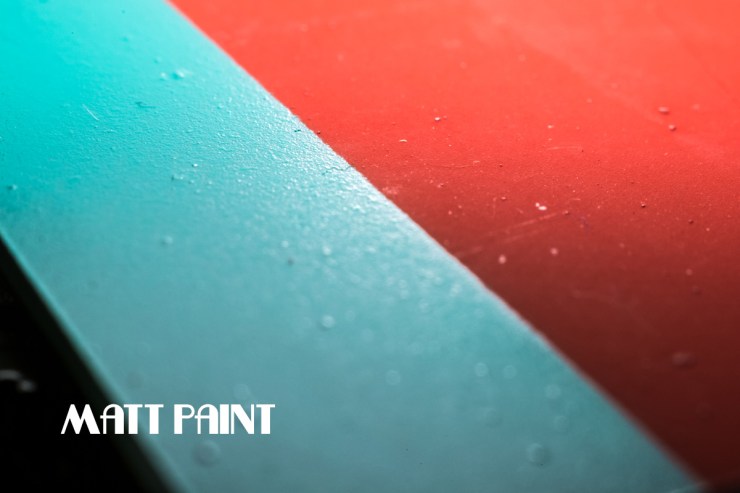
The fact that it was a negative effect meant that it could be hidden with a thick clear gloss varnish later – that saved the Banana.
What I surmise now is that I have been too anxious to speed through the painting process – and have not allowed the aqueous acrylic paint to chemically cure through its layers completely. Two hours wasn’t enough, even in a hot shop.
So I have sprayed four more red mules and will leave two of them for 24 hours before trying the mask test – and two will be left for a full 48 hours. I am loath to have to resort to the sort of time that enamel paints require for use – acrylics were so attractive on the score of quick drying. But I need some way to make sure that the aqueous paints I have will get used up efficiently.
Note that if I were using flat paints exclusively or lacquer-based paints I would not have this problem. They both seem immune to the undercuring problem. Or rather, to the problem of me making the wrong assumptions.
I will report the results in due course.
 The Little World
Leave a comment