No, you haven’t wandered into a Marvel comic – the blue mask of courage does not fight crime. It covers things up…rather like a bottled version of a parliamentary enquiry. Except it smells better.
Youve read here of my efforts to mask clear canopies on 1:72 scale aircraft by various means; tape squares, Humbrol rubber Maskol, MicroMask. white PVA glue, etc. And of my largely successful efforts to paint some canopies freehand with a bow pen. It is a task that I do not approach with zest, but as it has to be done for nearly every aircraft, you just have to pull up your BGP* and do it.
The really daunting ones are the commercial airliners and bombers with complex glass noses where the manufacturer moulds the entire nose of the plane in clear styrene, leaving you to paint in the bits that aren’t supposed to be windows. I did this for a Blenheim MkI and Bolingbroke by the tape square method and it really was not my best modelling experience. Later efforts to substitute the MicroMask or the Maskol for the tape were also marginal – there was a lot of flaking off of the paint on the canopy frames just where you wanted it to stay.
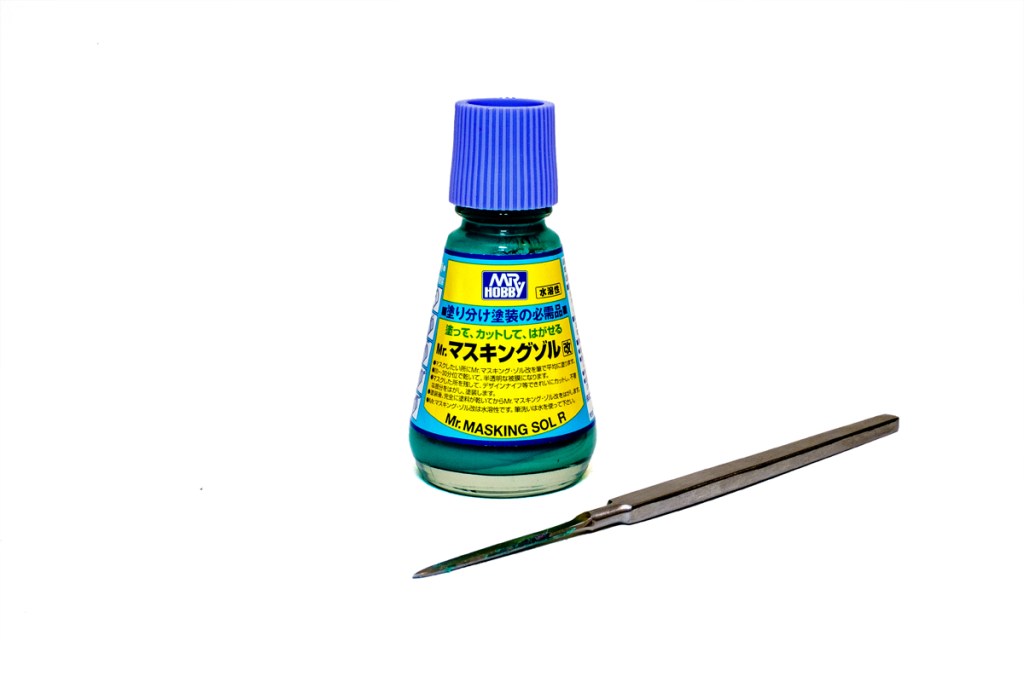
Well, always a sucker for the next big thing, I saw an advertisement on the GSI Creos pamphlet I’d downloaded that spoke of their bottled masking materials – Mr. Masking Sol Neo and Mr. Masking Sol R. They differ in that the Sol R goes harder when set and can be cut with a sharp knife blade to remove portions. The other one stays rubbery.
In a recent visit to a new hobby shop I found the Mr. Masking Sol R in the Creos stand and popped for a bottle. I knew I needed help with the front end of the Italeri CH 147 Chinook and I didn’t fancy trying to do it with tape.
The new blue goo went on very easily with the aid of my steel dissecting probe and could be pushed readily into the sharp corners of each window pane. It set quickly enough, but you needed to do the panels in sections and let each one set flat as it gelled off. That kept it precisely where you pushed it and didn’t let it run over the frame lines.
The paint layers for the Chinook were Mr. Surfacer 1000, then Mr Color in green and bronze-black, and finally a matt coat of Mr. Top Coat to flatten everything. I was delighted to see that the painting went perfectly, but still had a nagging doubt about the new masking material – had it leaked anywhere? Those solvents for lacquer paints are strong. Would it cling too much to the paint and chip off badly? Would it fog the clear styrene?
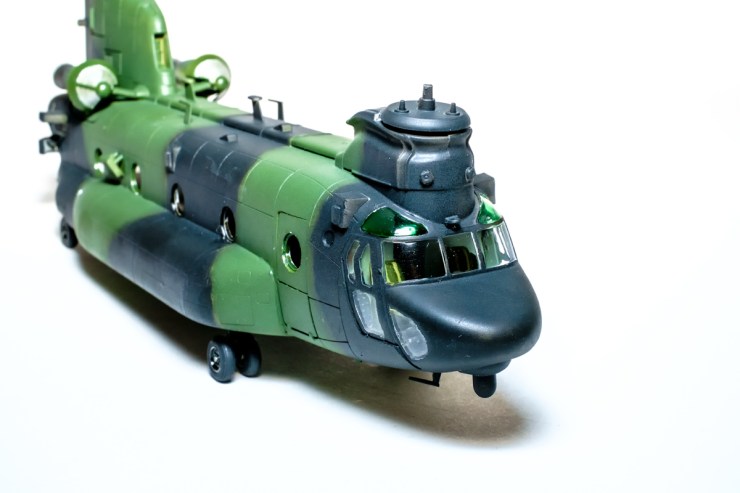
In the event, none of these fears were realised. it released beautifully, covered precisely, and did not leak. I have no idea what it would be like doing a British A or B camouflage pattern…but I am going to find out.
It looks like the GSI Creos boys score another 10/10 with this one.
* Big Girl Panties
 The Little World
Leave a comment