
The basic idea today was to see how much warpage by expansion or contraction would be produced by various adhesives commonly used in the Little Workshop for scale model building. The substrates upon which they were to work were selected from common fibrous sheet material; good photo-quality bond paper, thin card, and matt board.
These three materials frequently feature in card structures such as houses, hangars, and other 1:72 scale buildings. They are also sometimes incorporated in larger structures. It is always an advantage to have whatever adhesive is selected work quickly, but with some time for adjustment and for it to be durable. The real test, however is how much warpage or distortion it will induce in sheets of paper-based modelling materials.
This is nearly always a case of what moisture will do to the fibres – and some of the adhesives depend to a great extent upon water as a carrier for the actual glue. There’s water in the air as well, though Western Australia in summer can be dry as a bone. However, winter comes and so does the rain and what you glued flat one month may be curved in the next.
Seven forms of adhesive were chosen:
a. PVA glue – in this case Weldbond from Canada. Sellys Aquadhere is also a candidate but it is a less effective adhesive.
b. Diluted PVA glue – this approximates Sellys or any other PVA that has been diluted withe water for easier spreading. The small areas of models do not generally require as much trouble in glue spreading as furniture-making.
c. Contact Adhesive. This is rubber-cement Parfix from New Zealand. Cheap enough and less inclined to separate into component form in the tube than Sellys.
d. Clear gum glue from Officeworks. This is school project glue but not to be despised for that.
e. Balsa cement. Dear old glue-sniffer’s special C23 from Adelaide. Inclined to blurp out of the tube whenever the temperature rises but a standard of the industry nevertheless.
f. Uhu Glue Stick – the yellow gel stick glue that is so easy to apply.
g. Henzo paste – a specialty glue from the photographic trade. Made in Holland, it is neutral and safe for most photo mounting but may not be as permanently stiff as the other choices. Excess rubs off paper easily.
The test procedure was to spread glue on the three bases and then retire for a beer, letting them sit in the shop in modest heat. Here are the photo results:
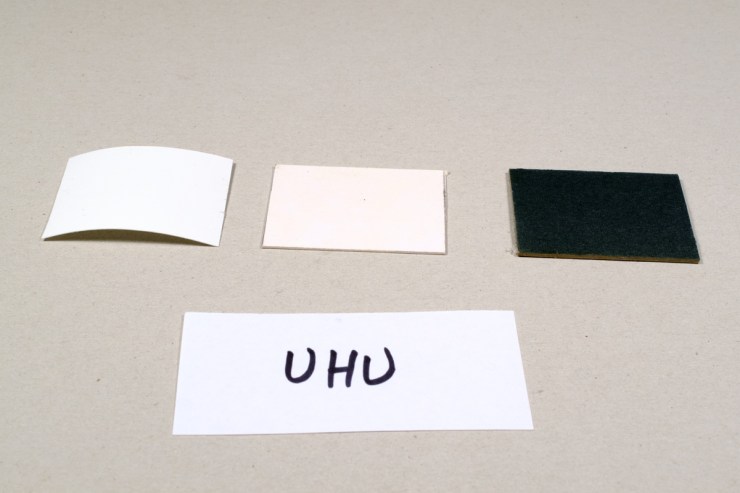
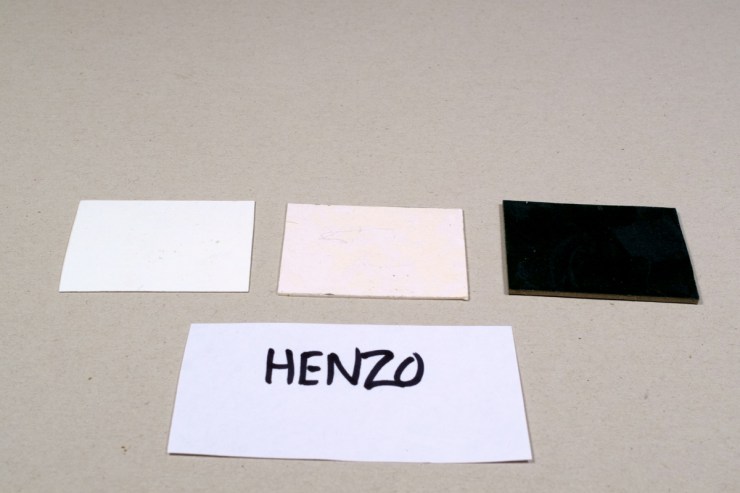
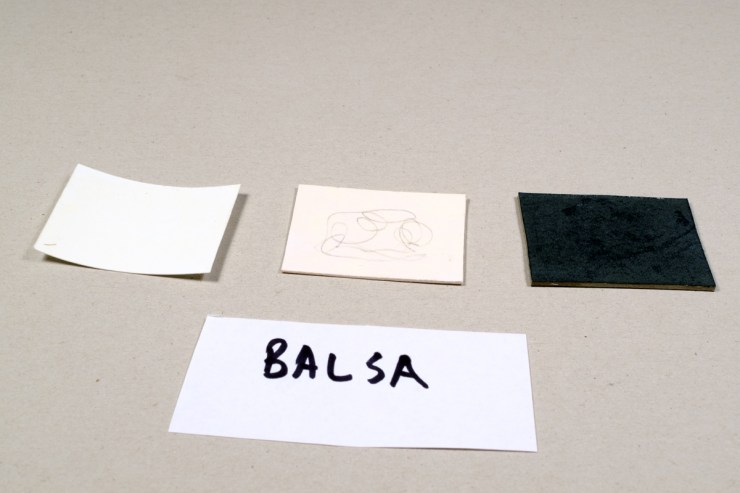
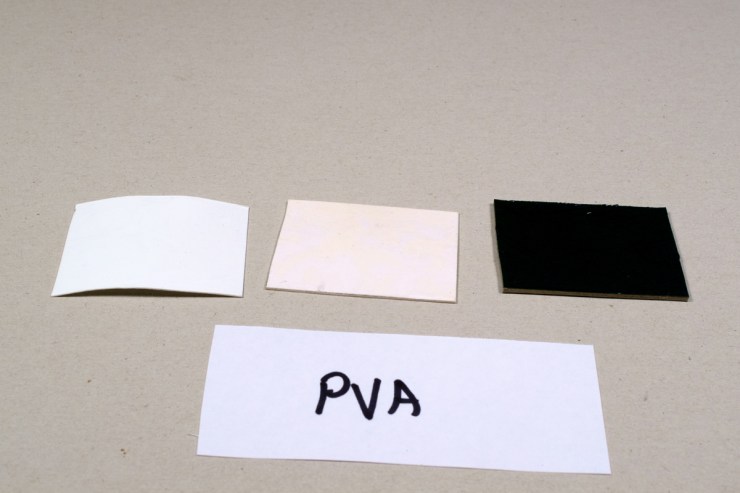
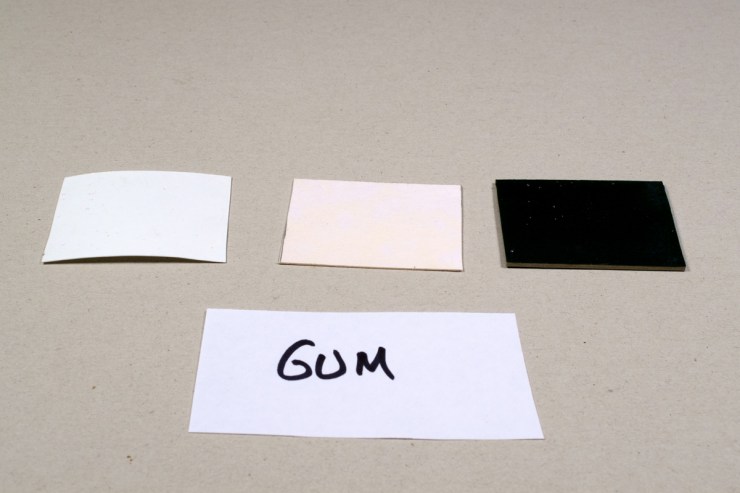
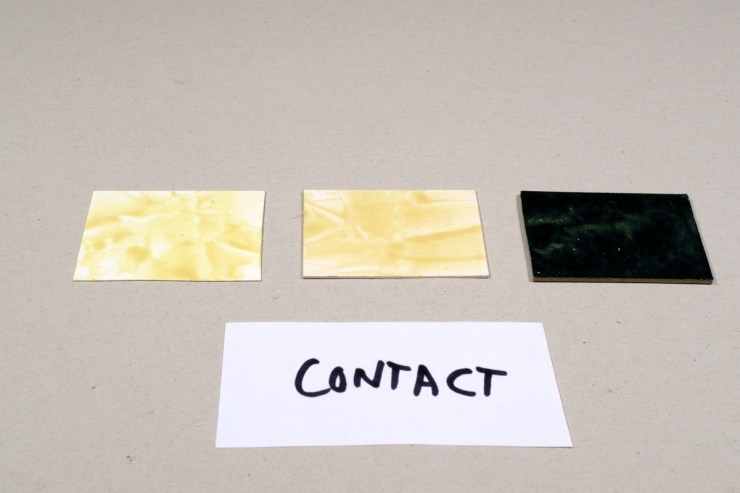

Notes:
a. PVA, dilute PVA, gum, and Uhu all induce a convex curve in the setting of the thin paper. I think the glue has penetrated the paper fibers and relaxed them so they expand and then has set in that expansion.
b. Balsa cement produces a concave curve. It may penetrate and expand but eventually its own contraction is far more powerful and it warps in the opposing way.
c. Contact cement and Henzo do not penetrate and do not contract in themselves – so the thinnest paper remains flat.
d. The structural integrity of the heavier card and board is such that in small pieces it can resist the pull of the adhesive. This is not necessarily the case with bigger spans.
Conclusions? If you need dead flat in a small piece of paper, use contact cement or Henzo paste to attach it. They may loosen in a few years but a big enough cemented area will cure this.
 The Little World
Leave a comment