Watchin’ all the birds roll by…dum de dum dum. Should put that to music – might make a good pop song.
Standin’ on a scale model tarmac, runway, racetrack, street, or hardstand is the subject of this series of essays. If you are repulsed by mathematics, just look at the pretty pictures.
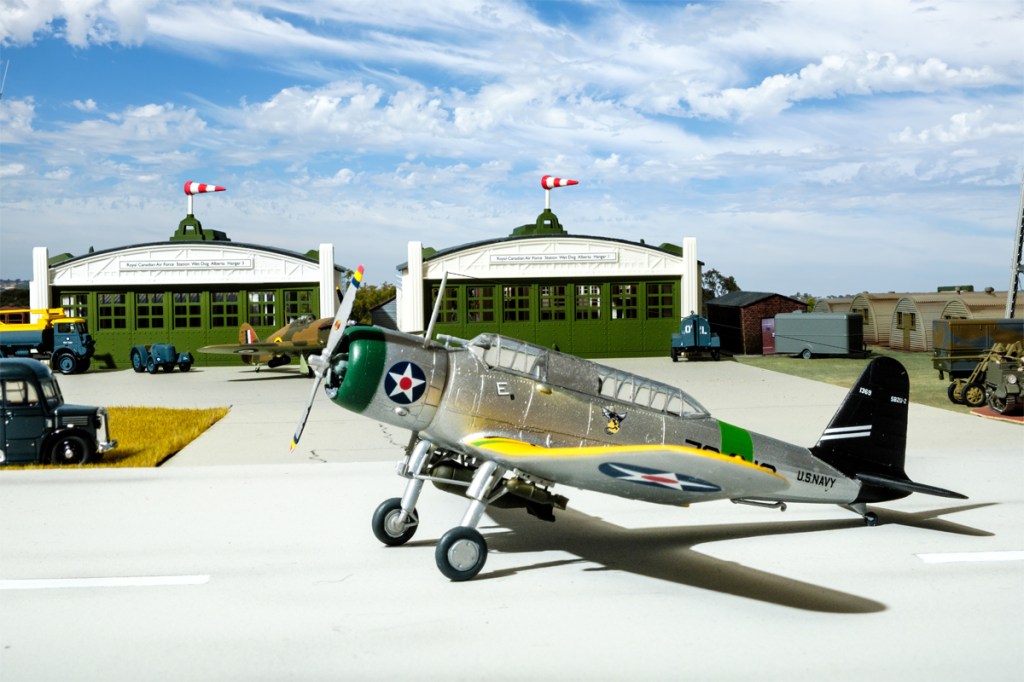
The Little Studio specialises in scale model photography – it also copes with live model photography quite well, but that is another essay. For now let us go down to the model airfield and try to make things look real.
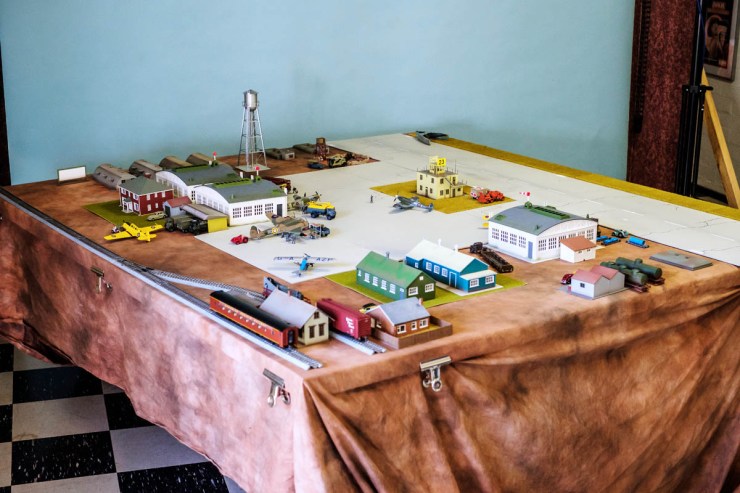
Didn’t do it, did I? That looks like a model set. There may be carefully wrought scale models and accessories there, but the whole effect is the same as looking at an OO train set on a ping-pong table. What did I do wrong?
a. Too far away. I see the studio surroundings.
b. Too high. Unless I purport to be taking pictures with a PRU Spitfire in a low pass, this is not what I expect to see. Real airport pictures are taken from the ground.
c. Too wide. Most camera lenses used in the WWII period were standard focal lengths or slightly long. Wide-angle lenses were uncommon.
d. Too colourful. And modern digital colours at that. WWII was a black and white affair for most photographers and very rarely went to Kodachrome A. When it did, it was in the hands of the professional units.
e. Two lights. There may be two suns on Superman’s planet, but Earth has only one. Hence, it shows only one shadow. Compare this to the Hollywood set lighting of the late 40’s and the absolutely abysmal television lighting of the 60’s. The student of photographic lighting can sometimes count six lights and tell you at what angle they are positioned outside of the camera’s view.
Some of these things are small matters – some large – but they all add up to a fake shot that is instantly perceived by even the least-expert viewer. The result may be a good illustration of what was there in the studio, but you can’t imagine that it is real.
Keep reading future posts and I’ll show you how to deal with each factor in turn. In today’s digital world it is a lot cheaper and easier to do good tabletop work than ever before.
 The Little World
Leave a comment