
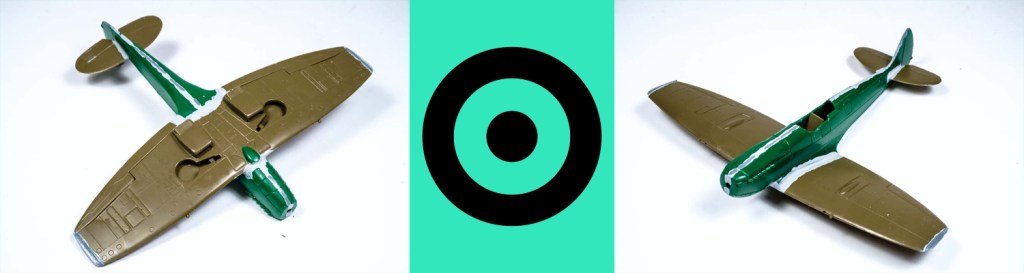
I am always in awe of the kit builder who has every seam perfect, every wheel straight, and every panel line scribed out. Awe and horror. Awe, horror, and unreasoning anger…
Well, it’s not quite that bad, but I do regard perfection with some suspicion. Fortunately the Matchbox Spitfire Mk IX is a very soothing model – as you may gather from the four or five different types of seam filler and undercoating agent it is wearing. I do not think we will be angering Heaven with this one.
I have been enjoying the challenge, and the changes that need to be made to make it conform to the historical plane are fairly easy- I chopped the tips of the wings off and fortunately had two aerodynamic tips from an RS model to cap the cut ends. The real plane had this modification done after the RAF and the Air Ministry experimented in the middle war period. They were trying to counter the newest German fighters that had a very rapid roll rate and the smooth long wingtips of the classic Spitfire were retarding this sort of movement. Chopping them off increased the speed with which the RAF pilot could roll after an opponent and did not affect the rest of the performance too much. Not as pretty a plane, but if it became a better fighter that really is all that need be said.
The main seams at the wing roots are very trench-like, though the fit of the parts is commendably true. I have purchased a tube of Vallejo acrylic putty and am very pleased with the way it stops up this sort of gap. The consistency is much more liquid than that of the Perfect Plastic Putty and there is a long plastic dispenser tip that lets you squirt the stuff down the cracks.
It seems to dry without too much shrinkage and then you can cut it off with a sharp Xacto knife. It feels almost like cheesy plastic as you do it and if you are a good knifeman there is little sanding needed. I am also using one of the older dental tools that we once had as students – the excavator. Mine’s a broken one but still retains one end with a sharp round spoon on the end of the contra-angle shaft. It is great for wing roots and areas where sandpaper will not fit well. I’m going to stop into Henry Schein Dental Supplies and see if I can purchase a new one with a slightly larger spoon and both ends intact.
This is likely to be harder than you’d think. Even though i was a dentist for 40 years and paid tens of thousands of dollars to Henry Schein over the decades, they really do not want to see you after you have retired. Any time I call in there looking for inlay wax or investment plaster or anything that I knew as useful in the old days they put up a tremendous fuss about selling it over the counter. But I am persistent and eventually they give in and take the money…A very odd business model.
Of course the Perfect Plastic Putty gets used as well for subtle filling tasks and then wet-sands out wonderfully. I do not do as so many people advise me – they all say to smooth it with a wet finger after applying it from the tube. I am frugal and apply it with a stainless steel cement spatula. You can get these from the hobby shops and they are every but as good as the ones from the dental supply warehouse – but you can also count on many of the rubber impression materials being supplied with throw-away metal spatulas that are far too good to throw away. They are thinner and more flexible than the hobby shop ones and I suspect that your dentist probably has a jar of them under the counter in the lab that he would push at you if you asked. I am going to go bail up the chap who bought my surgery and see if he’s got a few.
 The Little World
Leave a comment