
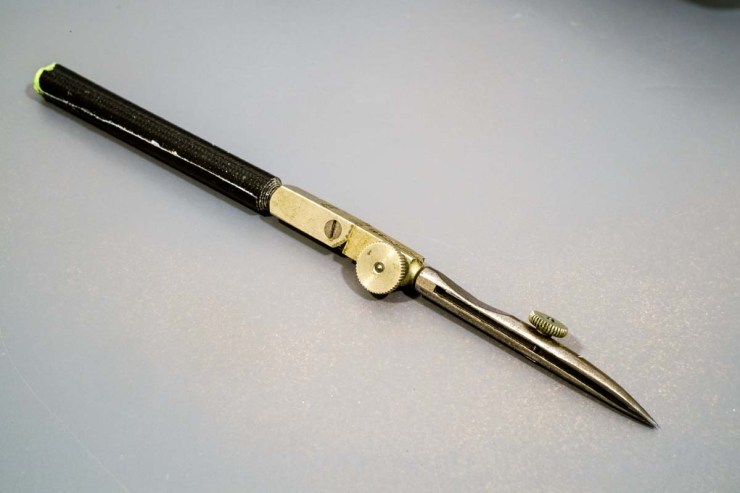
An earlier post mentioned the draughtsman’s bow pen as an instrument to paint the lines on 1:72nd canopies and I sad I was going to experiment with it. Experimentation finished, I have decided that it is the preferred method of work for the future.
I admire the people who can mask canopies and spray paint them to leave the struts and frames as clear lines. I read about their efforts in the model press and watch the YouTube clips of them doing it. I have also tried to do it, but have encountered no-end of problems. Failure to get the masking tape to adhere, masking solution creeping away from the places it is supposed to protect, flaking and loss of paint at the time of unmasking…the list goes on.
I realise there are techniques and tricks that overcome most of these problems, but they never seem to overcome all of them at the same time on any one model. Some of my early masking attempts were crudity itself.
On the other hand, my efforts with the bow pen – and to a lesser extent a fine brush – are bearing fruit and I am getting better as I go along. There are a few points i’ve discovered:
- Acrylic lacquer paint is as easy to use as the aqueous acrylic, but you need to be aware that the vehicle evaporates faster. Thus I mix less of the paint in my tiny tin dish when I start out, and refresh it more frequently with the Mr. Color levelling thinner. This has some amount of retarder in it so it can stay liquid longer.
- The adjustment of the bow pen is critical – just a smidgeon of tightening on the wheel is enough to make quite a difference for the flow of the paint. Dilution is not going to be precise every time so you have to try it on a scrap of plastic when you charge the pen to see what adjustment is needed.
- You must wipe the top and bottom of the jaws to clear the pen before you start to apply it to the canopy.
- The technique for the line is different, depending upon whether the kit maker has included raised frame lines on the canopy or not. If it has raised frames, you paint with the side of the pen – if there are no raised lines you paint with the tip, making the line yourself.
- Paint under the edge of the canopy as well as on the outer edge – this makes the canopy frame look much more solid.
- Paint symmetrically. Do one frame line on one side and then the corresponding one on the other side. When all the outer frames are done, join them with the centre bars.
- Don’t be afraid to put the canopy aside for one section to dry before adding the other bits.
- Hold the canopy with BluTack on the end of a small dowel. It’s a great handle and you can grip the job firmly. Never hesitate to stop and make a big enough handle for the small parts so that they are held firmly.
- Let the fingers of one hand join with the fingers of the other as you paint. It’s an old dentistry trick to allow steadiness with a moving part.
- If you’re long-sighted, get close-up glasses or a loupe. if you’re short-sighted, take your glasses off and hold things closely. Ignore the hoots of the spectators. You’re modelling your way.
I stop every now and then to clean the pen with lacquer thinner and refill the tiny tin dish. Fresh paint flows well.
I noted on the YouTube a young chap from Canada who is hand-painting his 1:48 scale canopies with a brush. I would like to find the same brushes he uses, and will look more closely at the expensive ones in the hobby shops.
 The Little World
Leave a comment