
Every model kit build has a point that I hate – in the case of the R/C ships a half-century ago, it used to be the carving of the hulls. Now its the masking of the canopies and the cockpits on small airplanes. The tasks were and are small but the daunting is big.
As I have taken to bow-pen painting my canopies, I need to protect the open cockpits as I spray the fuselage and wings. I’ve tried everything – wet tissue paper. masking tape covers, foam blocks…each works but only to a limited extent, and the work involved can be irritating. I am never actually certain the cockpit won’t absorb stray paint, either.
The advent of a good Academy B-17 kit and then the Airfix Whitley set me to thinking – and experimenting. The Whitley was supplied with an early and a late clear canopy – I needed the one with the astro-dome for my model but the other one was going spare.
As it fitted the opening perfectly, I thought of cementing it into place with a temporary glue ( PVA ) and then painting away on the fuselage. When the time came I would prise off the spare, and glue on the pre-painted real canopy.
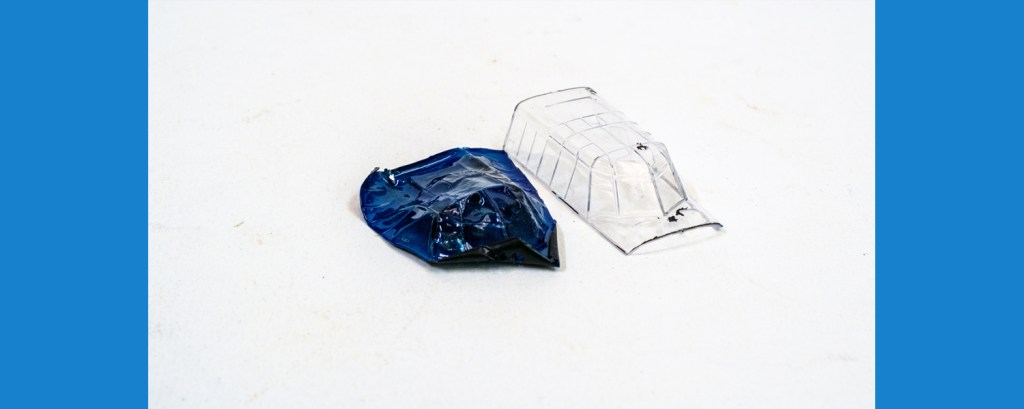
A further refinement was to pretend the spare canopy was the final one and paint it with masking solution first. Then I could see whether I might get away with it for real. I coated it with the blue Micro mask material as a test.

The test worked well – no paint seeped under the edge into the office, and the temporary glue let go as expected – the heading image shows what the spare canopy looked like after i peeled the mask off. A couple of paint dots leaked through but these were easily cleaned up. The experiment was a success, and I will see whether it can be used on a regular basis to avoid the fatigue of masking tape and foam blocks.
 The Little World
Leave a comment