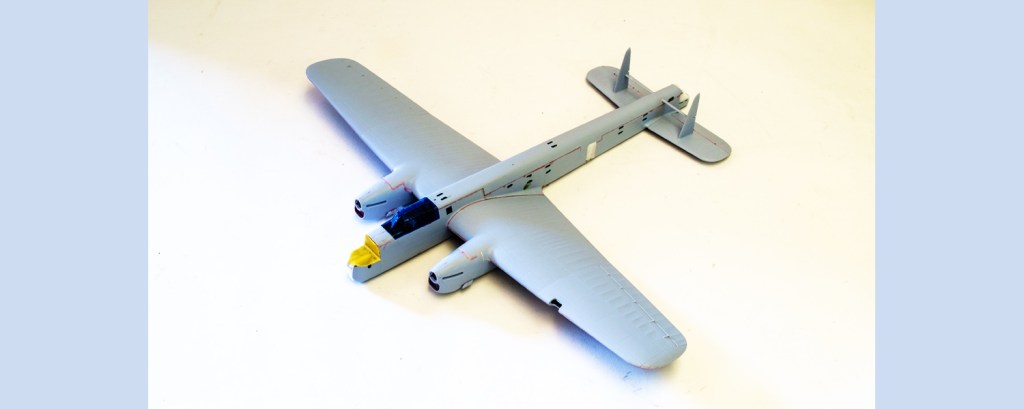
That magic stage of a build when the sprue trees have blossomed and fruited, and we have a recognisable airplane on the bench. It is one of the most heartening experiences in a modeller’s day.
Of course some people spend literally weeks detailing subassemblies and parts for the eventual assembly, but I like to get the thing nailed together early. There will still have been all the work of the interior and cockpit, and odd moments will have been spent painting and sub-assembling while glue set or paint cured, but this is the first reward stage.
The three-part fuselage went together well. I know some people decry the modularisation of kits with separate noses and tails – a ploy to make one mould serve several versions to gain more sales. And if the modular sections are ill-cast and do not mate properly the kit is certainly a candidate for the reject shelf. However, when the intended engineering comes off, the thing can be a delight. Good, tight liquid cement and MEK seams and no big filler traps.
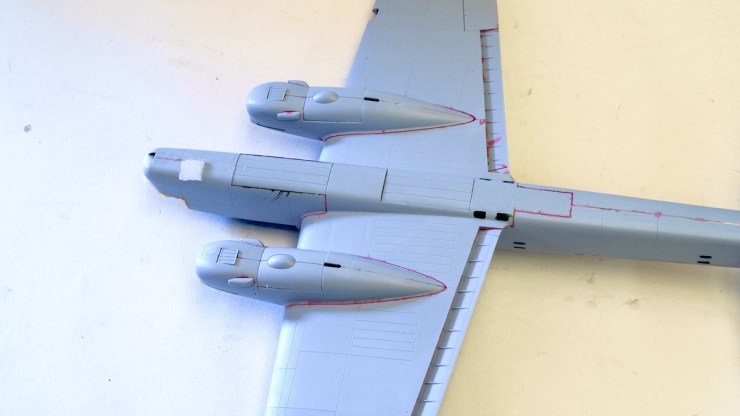
The wheel well covers are the parts that are normally reserved for the wheels-up flying version of the plane, but I have temporarily glued them to the apertures to serve as a painting masks. Which brings us to the canopy section and that new-to-me technique.
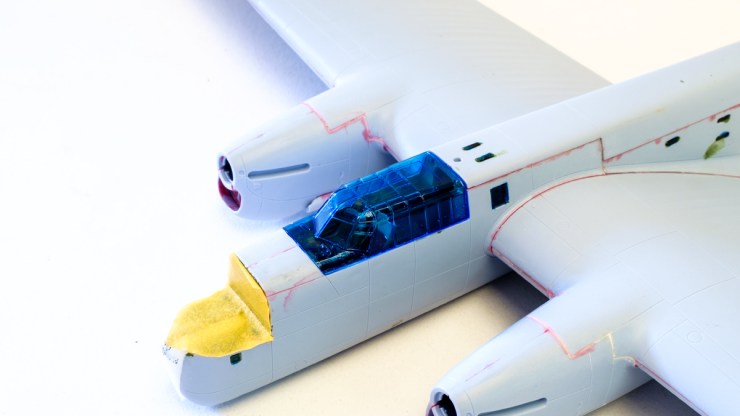
As you know, I paint my canopy framing with a bow pen – rarely gluing and masking the things in situ. So I need to occlude the cockpits of most aircraft for the undercoat and paint stage. Heretofore it has been an exercise in geometry with masking tape and foam blocks – frequently needing to be re-done in the middle of a spray job. I decided to try the experiment of painting the outside of the clear plastic canopy with masking fluid, gluing it on temporarily, then spraying away for the various coats.
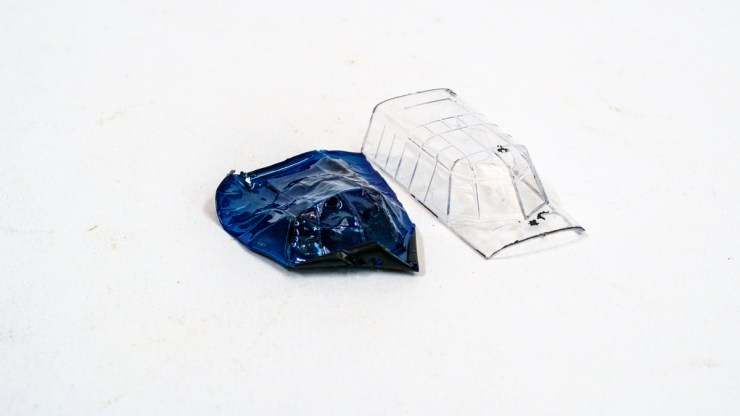
It was not all bravery – I did try a test piece with a spare canopy. Here is the test piece with the blue mask removed after painting – only a very small spot leaked through. I put the real canopy on the plane and gave it several coats of blue. The mask is the Mr. Hobby solution, though I have also tried Humbrol’s Maskol and think it is actually a little better.
 The Little World
Leave a comment