
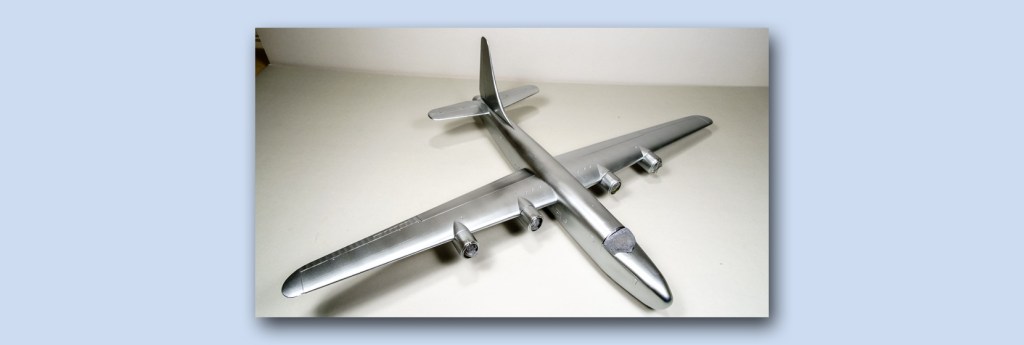
I admire the model builders wo make aircraft that have complex camouflage schemes – the ones that tackle the german or italian schemes of the WW2 period – or any of the WW1 schemes – earn my respect and praise. yet i very often do not follow them.
It is not for want of trying – I have attempted an Italian mottle before and done it with a modicum of success. It is not for lack of paint – goodness knows we have a variety of choices at the hobby shops, virus drought or not. It is not for want of information – every kit has some form of instruction call-out and the internet is full of reference material ( some of it questionable…).
What I do paint a lot of are big silver planes. I think it is because in my childhood the RCAF and TCA aircraft I saw were mostly silver. The USAF planes of the time also, though these were just images in magazines or on a black and white television screen. I flew as a passenger in some airliners and saw others taking off from the Calgary airport. Planes were silver…
So you can understand why I follow the hints and tips on Phil Flory’s modelling YouTube channel whenever he deals with metallic finishes. So far I have learned:
a. Use metallic paints – not just silver spray cans from Bunnings. I did once on a Flying Boxcar and did not get the shine that the box art promised. A learner’s mistake.
b. Do not use metallizers unless you are doing small, perfect models. The metallizer paints are thin and finicky. Hell, I am thin and finicky and it causes enough trouble as is.
c. Paint over as good a surface as you can produce. That means filler, sanding, primer, and a black base to let you check the condition before you blow silver.
d. Do it in thin coats. A very thin one first – a dust, indeed. Then a bare coverage. And then let it set and gas off for a good while before going back with the second cover coat – this one can be the final if it is a good very job. But if needed, a third coat of thin paint to finish before the decals. You can only jusge when the second has dried thoroughly.
I have transgressed this ruling on a number of occasions by mistake…and a number of others through hubris…and paid the price in a bad finish. It is always better to go light and careful.
e. Use adequate jigs or supports to hold the model – not your fingers. Do it in a top/bottom split with drying time in between. A whole afternoon to do the successive coats is not a bad idea, and at the end you let it all sit undisturbed overnight.
f. Spray from front to back on the fuselage, tailplanes, and wings. The slight striping may not make it through to the finish coat, but if you miss a small patch it looks like the normal streaking in the airflow.
g. Remember to do the gear doors and other silver bits at the same time.
 The Little World
Leave a comment