
Well, the experiment was a success. We can now create artificial life in the zombies at the SMCWA clubrooms. The only difficulty will be telling it from normal behaviour.
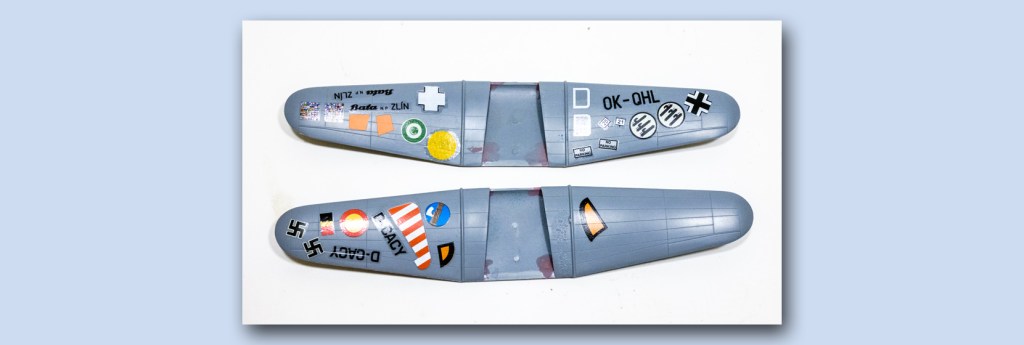
I set up a standard soaking bath for the decals I wanted to test. There were plenty of unused ones from various makers so I carefully identified them and got a couple of spare wings to act as receptors. No paint on the wing – raw plastic.
I set out a piece of paper towel thoroughly saturated with plain water and a stop watch. The test was to determine if decals would float off and be applicable with a simple resting period on the wet paper towel. Also to see what length of time would be needed for this. And then to see if a preliminary dip in water would speed this up significantly.
Here are the measured times for a successful transfer:
a. Hobby Boss.
40 seconds to release and float off. A 5 second dip did not speed up this transfer time.
b. KP.
20 second release time – a 5 second dip shortened this to 10 seconds on the wet towel.
c. Airfix
40 seconds release time – but a preliminary dip did not shorten this time at all.
d. Home Inkjet printed decal. This is on Testors or Mr Decal paper.
40 seconds to release and no speeding up with a dip.
e. Ventura. A new Zealand firm with horribly thick decals.
These took 60 seconds soaking to release and lay properly – you could marginally reduce this with a 5 second dip. But the decals would have difficulty stretching over any curves.
f. Italeri
These took a full 120 seconds to let go and float off. If you dipped the decal for 10 seconds you could reduce that time to 90 seconds.
g. Smêr
These took a full 60 seconds to start moving. At least they didn’t tear in this test.
h. Heller
60 seconds for release and laying. Did not speed up at all with a preliminary dip.
It will be noted that all the decals went down over Mr. Mark Setter and snuggled as closely as they would in other circumstances. The really crude ones do not readily conform to the panel lines anyway. With no excess water during the application, there was a lot less water to squeegee up from the models.
 The Little World
Leave a comment