

If you look carefully you can find a use for everything. This was the principle behind the acquisition of the Handley Page Jetstream aircraft that were to have been a part of the USAF transport fleet. Eventually rejected by the US Air Force due to delays and engine problems, the medical turbo props were sold off to whoever would buy them.
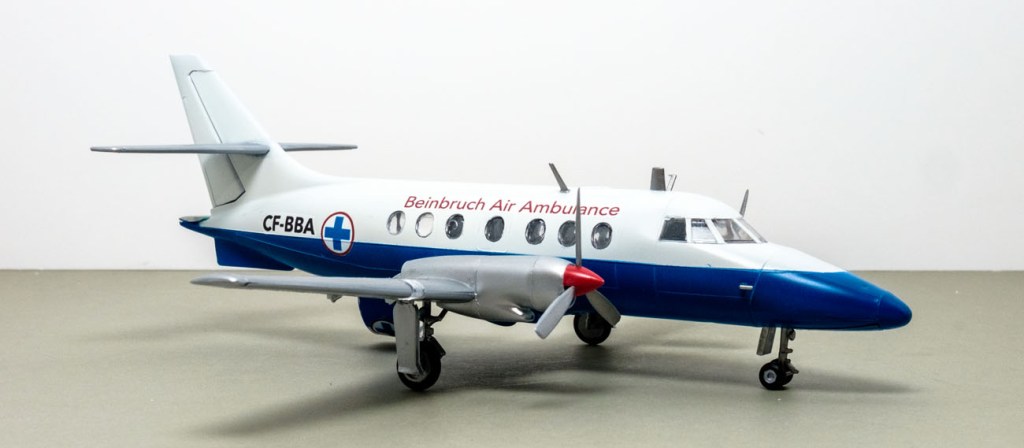
A number went to pickle-packing firms for delivery of Polish dill pickles to provincial markets, but one ended up on the roster of Beinbruch Air Ambulance service. This company specialised in the rescue and recovery of skiers who had become injured in the Canadian Rockies. CF – BBA was assigned to the Okotoks Mountains – Calgary run and plied the trade every winter.
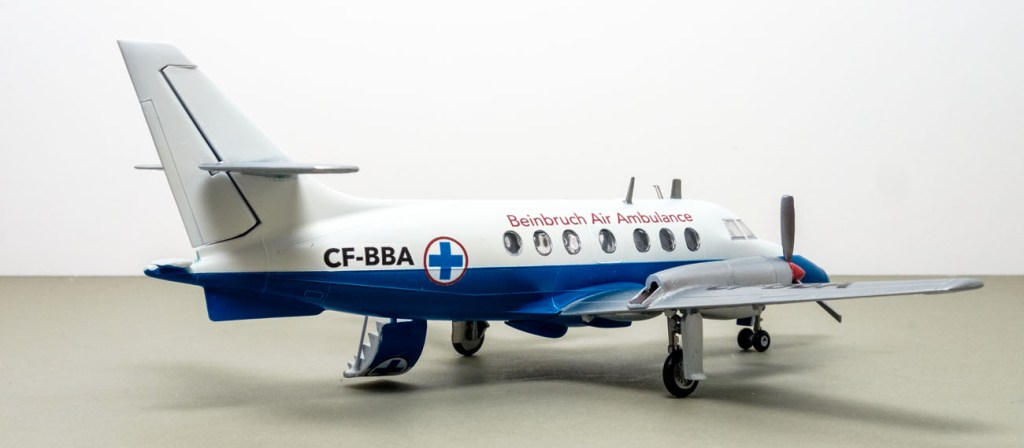
If you booked ahead you could have a window stretcher. Frequent fliers got a book of discount vouchers and a free bottle of pain-killers.
The kit at the end was as good as Airfix could do at the time. Had I been more eagle-eyed I would have picked up the sink marks. As it is, I regard them as dents in the aircraft’s skin, and I’ve seen enough planes with those…
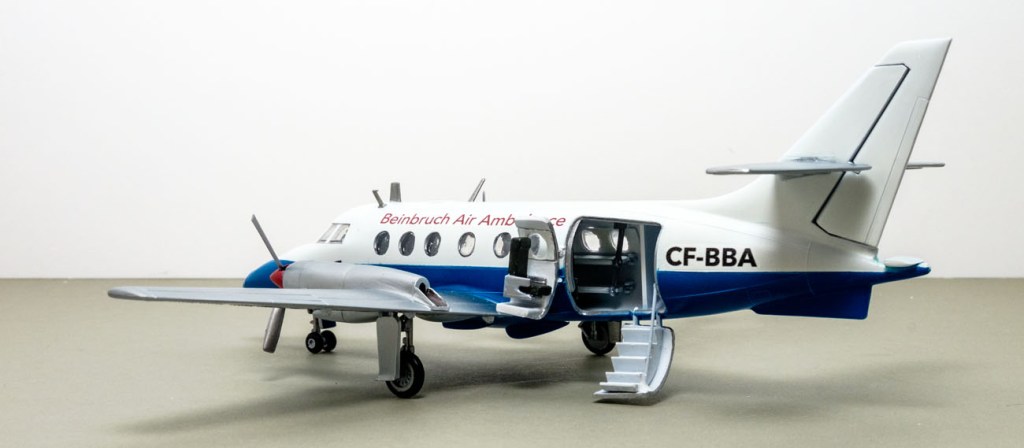
The interior is a little clunky, and fully visible at that, but where else have you ever seen an air ambulance? The stretchers have blankets with a red stripe on them because red stripes are better. I haven’t seen a scale plan for the pickle planes with their big wooden tubs yet, but they would also be a good one to build.

In the end I think I got my $ 29 worth no problems. I did use the traditional mask and spray method for the cockpit window framing and am becoming more comfortable with it. I think my first venture into masking – the Airfix Bristol Blenheim I – was a bit of a hard exercise. I’ve also discovered that you can discretely clean the windows of mild overspray with a Q-tip and isopropyl alcohol.
I can’t wait to see what other planes Airfix will dig up out of the archive vaults to reproduce. So far they’ve been a delight.
 The Little World
Leave a comment