
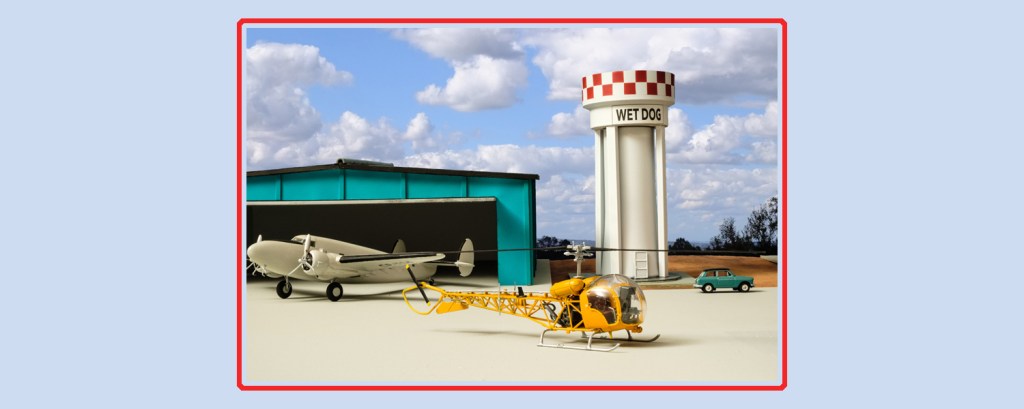
I do love a good hangaring, don’t you?
Walking around a vast space filled with extremely expensive aluminium and trying not to let any of it drip hydraulic fluid on you. Occasionally hitting your eye on a propeller blade ( or on a turbine blade if you are nosy and short-sighted…). Tripping over hoses and cables and people underneath things, swearing. It’s better than Disney World.
I have been using three Plasticville Airport Hangars at Wet Dog since the base was established. They are ostensibly for an O guage railway, but pretty silly in that 1:48 scale. However, if you wink your eye at the side doors, they make pretty good accessories for the 1:72 size. And they are still available on the internet new.
They do not, however, have enough capacity to take a twin-engined airplane of modern dimensions. So the Canadian Department Of Transport is going to have to move them off-site and build three new ones – one a double arch monster. Fortunately the cost of foamcore board is low at present and the budget may even stretch to some Plastruct re-enforced metal roof trusses.
The subject of aircraft storage seems to have attracted attention all the way from garden shed builders to major architects. Some really spectacular art-deco affairs went up all over the world in the 20’s and 30’s and some resemble cinemas rather than hangars. The associated office buildings and terminals are even better.
Canadian hangars are different from Australian ones – they have to fight different climatic conditions. So there is a different choice of materials and shape. I’ll have to go further than just looking at the local airport to get accurate information about the structures. Okay, they all have a door at the front and a toilet at the back but there’s gotta be other features.
There is also the business of what you fill the hangars with – in addition to aircraft. This can be a whole new world of scratch building or adapting model railway accessories. As a hangar has a big, wide door of necessity, the contents will be visible all the way to the back. I think that this will be the answer for something to do when a frugal week comes round again – strip styrene and bits of wood are inexpensive and paint and signs make all the difference. The buildings of the Air Museum filled quickly with smaller aircraft and the walls proved perfect for advertising and historic posters. Thank goodness for a working inkjet printer.


 The Little World
Leave a comment