I am always astounded at the enthusiasm of the Czech kit makers to produce ever-finer sheets of photo-etched brass.
The Curtiss Goshawk has just such an offering, asking me to make throttle handles as fine as a hair. I have acceded to their demand to the extent of producing two fuel tank filler caps with chains but I cannot see well enough to make the handles. In any case they cannot be perceived by the naked eye and my eyes are not even that good with clothes on anyway.
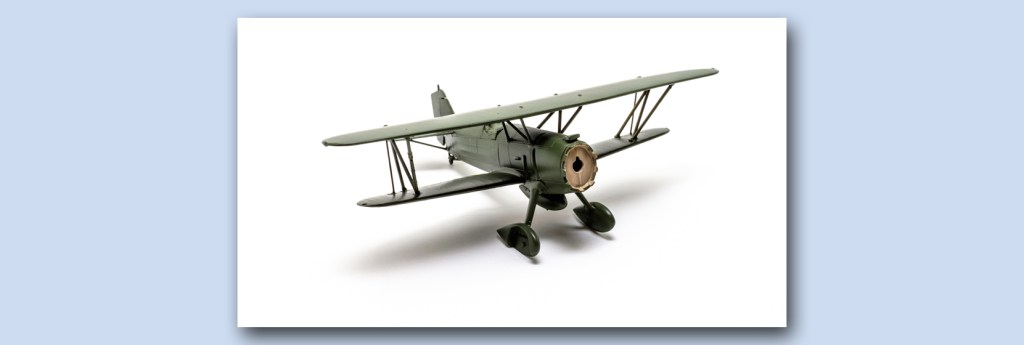
But the rest of the kit in resin and injected plastic is going very well indeed. No filler in any seam line and the wings and struts joined with no major hassles. I think I may be getting some clue as to how to do these – I measured the attachment points and made up a foam plastic block to hold the struts at that angle – then cemented them onto one wing only. I chose the top one for the Goshawk and let the struts dry for several hours before I offered them to the fuselage and lower wing.
The strut attachment points themselves were indeed drilled out to comfortable depths based upon the tiny marks moulded into the wings. The slot was podged out to make it the shape of the strut and and thin cement puddled unto the depression. A drop of regular cement on the end of the strut prepared it to drop in and grip very quickly.
After final assembly, more thin cement and then cyanoacrylate secured the struts in place permanently. Full marks to RS models for the accurate geometry of the entire thing – there was no warp. Even the tail and tail struts matched the markings.
I should have been very nervous with most of this had the research showed that the real aircraft carried camouflage. The Swuping Air Army will use various schemes but this one is the simplest. I’ll paint any of the Chinese schemes I can verify, but it will take a plain monoplane to advance to tiny line camouflage.

Note the Curtiss-Wright engine has both wiring and pushrods. Nervous stuff.
 The Little World
Leave a comment