
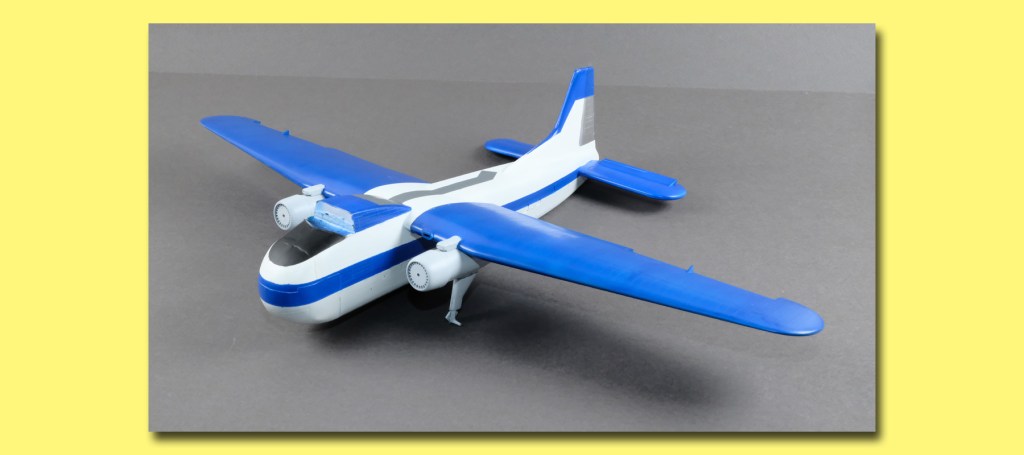
At a certain point in the build, your new airplane becomes a nuisance.
Up until then, it is a manageable fuselage, some tailplanes, and a pair of wings. Or many wings, if you are making a bi or tri-plane. All the parts can be kept in the original box.
When the erection stage comes around, you are faced with an entirely new shape. It will occupy far more space and your workbench will be taken over. You are now committed to either finishing it or selling the house and getting a bigger one.
The Airfix Bristol Superfreighter kit that this model is derived from is a 1959 mould and has the classic tab-and-slot wing attachment. This was moulded very well indeed and needed only some scraping and squaring to allow the wings to but to the fuselage perfectly. There was going to be a large cementing area to unite the parts.
First wing was easy – cement coated both surfaces with a slow, thick cement, and let them ease into each other. The fuselage rested on its side while the wing cured in place. Hours, as it needed to be a strong joint.
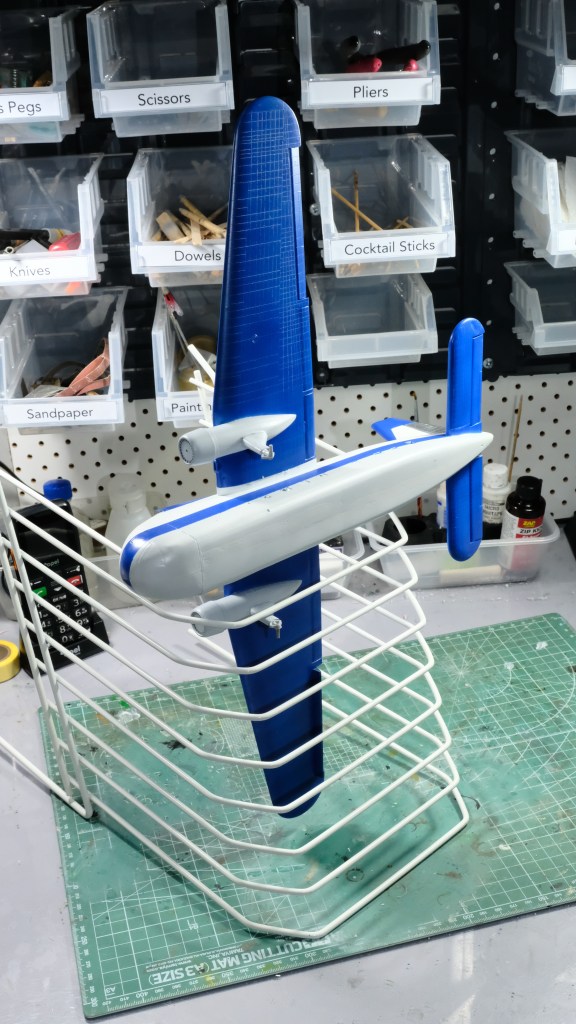
But what to do next – the wing was extremely long. Not as bad as a B-29, but nearly…
1960’s metal LP rack to the rescue. We all have one of these about, eh? Balanced the fuselage and added the second wing – gravity holding things in alignment while chemistry did its job.
It was probably like this in the Bristol factory at Dorval…but in colonial French…
 The Little World
Leave a comment