

Because if there is, I want to know all about it. I love horror stories and the things that people invent to do for themselves in their modelling workshops are no exception.
Oh, I don’t mean the accidents and mishaps. I can cut my fingers or spill thinner into the electric fire myself. And who of us hasn’t enjoyed the enamel paint and new trousers game? No, I’m referring to the ways and means that modellers think up to be way mean to themselves. I like to think of it as ” A Guide To The Masochistic Modeller “. If you want to know more, punch me…
a. I did my fast, free reading in a modelling magazine round the back of the newsagents rack and found out that someone was prepared to descend into the bowels of madness to make a patch of fake grass on a model plinth. And wanted us to follow.
The technique, as far as I could make out, involved multiple paint colours, a packet of plastic fibres, an electrostatic machine, glue, scissors, and quite possibly a long day in a short life. After all the steps were completed and most of the smell had gone out through the shattered window, a plastic German tank was put over the patch of grass.
I was impressed, as you can tell…particularly since my own answer to a patch of grass is to buy a patch of Heki or Busch grass and stick it down with white glue.
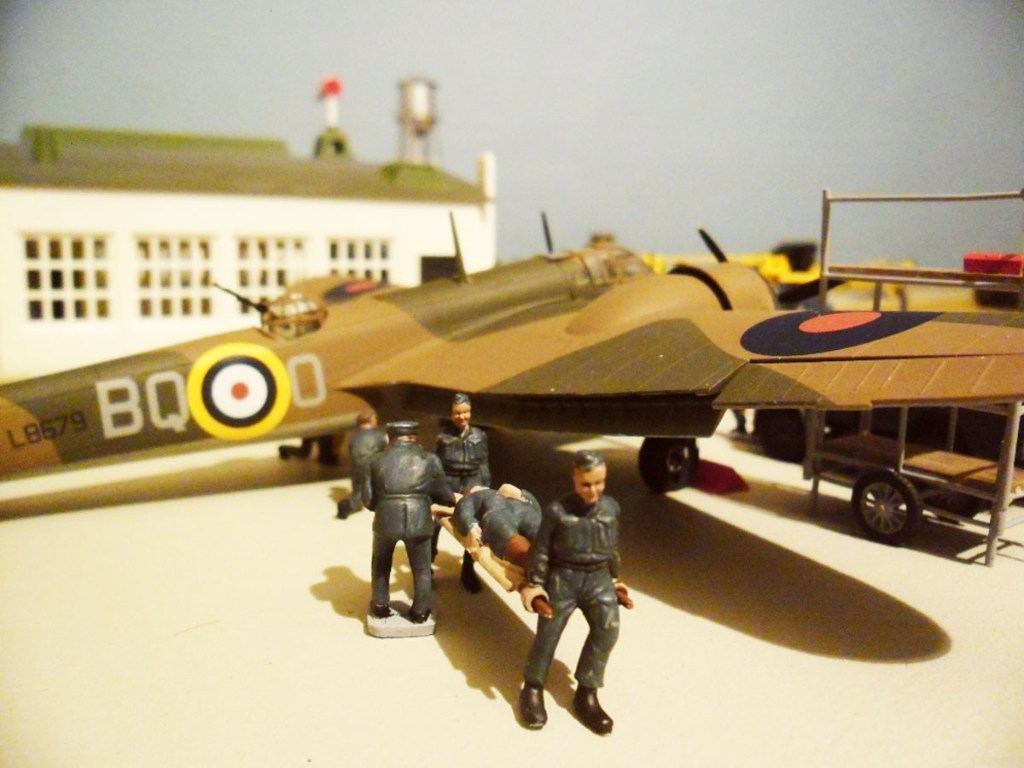
b. I realise that there is more to painting an airplane than dipping it in a bucket of Dulux and hanging it on the clothesline to dry. That might have done for the RAF but they were not modellers. Hence the perfectly simple advice for scale modellers to preline, preshade, basecoat, mask, top coat, post shade, dot and streak, spray varnish, decal, spray varnish, buff, and spray matte.
Had the Air Ministry followed these instructions the Luftwaffe would have been landing at Biggen Hill for weeks before the first Hurricane took to the air.
Oh, I realise that most people don’t follow all the steps – they mix and match – but somewhere there is a diligent person at the bench with a plane sporting 46 separate coats of colour on every surface. It is too heavy to lift, let alone fly, but it looks magnificent.
c. Masking canopies. You can do it the easy way or you can do it the hard way. Or the very hard way. Or the excruciatingly hard way. Your only limitation is time and your knowledge of swear words. Get more of either and you can go onto the harder techniques.
I’m currently at the bow-pen and florist’s tape stage but I am hoping the model shop will get in a new supply of unborn emu bladders so I can try the latest technique.
d. Ballasting track. It used to be simple. Put the track down on a roadbed of cork, pour tiny gravel over it, swoosh it about with a brush, and then squirt thinned glue over it when you were satisfied…or when you just couldn’t stand the work any longer. Eventually you got good at it and if you went to the trouble to trespass on the railway lines to see what their ballast was like you could cope with turnouts and crossings.
Now there are ballast spreaders, electrostatic guns, vacuums, and for all we know a miniature tamper train. I have recoiled in horror from it and just bought Kato snap track with plastic ballast included. I used to sneer at Märklin M track as too simplistic but I sneer no more. It actually appeals to me.
e. The Craftsman Kit. Now these can be admirable – kits that provide such precise and accurate wood, metal and plastic as to defy any criticism. Plans that are drawn, not just to scale, but to time and weather as well. Results, in the end, that look just like the pre-made structures next door on the hobby shop shelf, but at a fraction of the price.
I am all for this, until the fraction becomes 87/100ths of the pre-made price. When you figure the paint and the adhesives and you get to 100/87th ratio it is time to sit in the shade with a lemonade and think.
f. The construction of a cockpit for a plane or the interior of a car is one of those forks in the modeller’s road that change forever their destiny. It may also change their eyesight, sanity, family relationships, and vocabulary. The sort of test of character that used to be provided by charging Russian guns at Balaklava.
Considering what is supposedly required of me in ever-smaller parts made out of ever-more-difficult materials, it is test that I am prepared to fail with delight. My detailing includes the major parts; inside, outside, and a seat, and after this I regard any further attempt to detail it with dials, sticks, levers, knobs, and switches as pure folly.
NOTE: I see from a US model weblog column that there is a phrase ” Barney builder ” that describes someone who is not obsessed with changing from kit detail. I am considering having a pair of sweat shirts emblazoned with this. I know another person who would wear it…
 The Little World
Leave a comment