
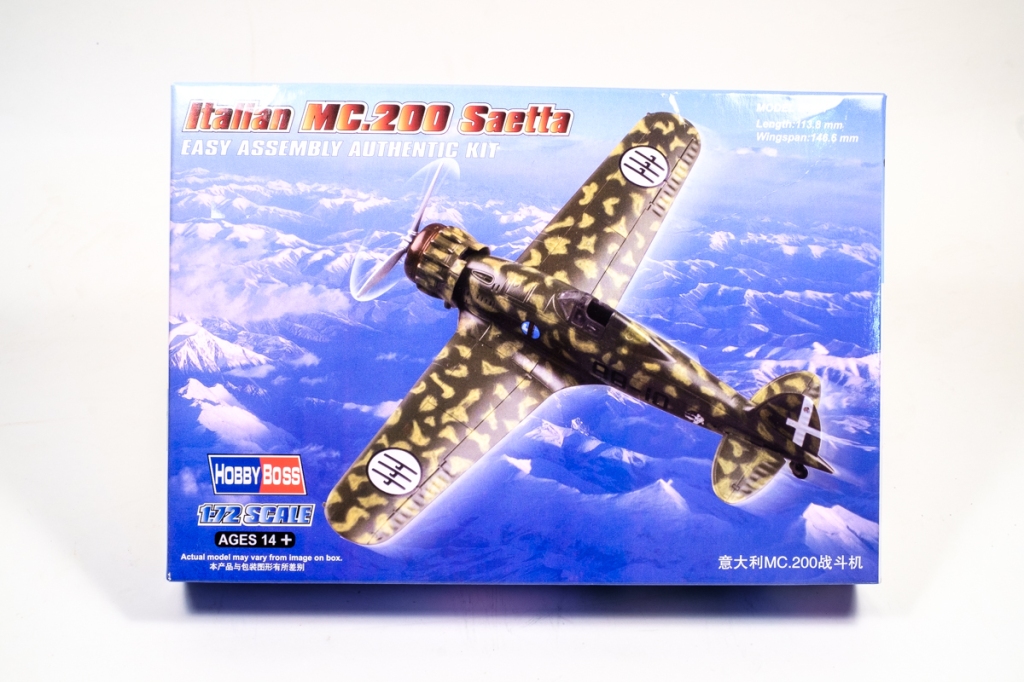
I can see that there has been a phone call from Italy. Hobby Boss has put out their 1:72 model of the Macchi MC-200 Saetta fighter plane with no reference to ” Macchi ” on the box. It is referred to only as ” Italian ” and ” Saetta “. It’s the same story as the Minicraft boys and their kits of Ford Model A cars in 1:16th scale that never actually say ” Ford “. It’ll be one of those commercial standoffs – The Italians want license money and the Chinese don’t want to pay it. Fortunately, the modellers of the world can carry on gluing and painting while the Mafia and the Tong slug it out. As long as it doesn’t stop the factory I really don’t care.
This is a little cheap kit, which means that rightfully it should be a little horror. As it happens, it is exactly the opposite – so far it has proved to be a little gem.
The usual fanciful box art is present, derived from a photograph. I would be interested to know what mountains the Hobby Boss aircraft are always seen flying over. Chinese, one presumes. The contents are spare – but superbly packaged, as usual. Hobby Boss make sure you get what you pay for, and get it in good shape.
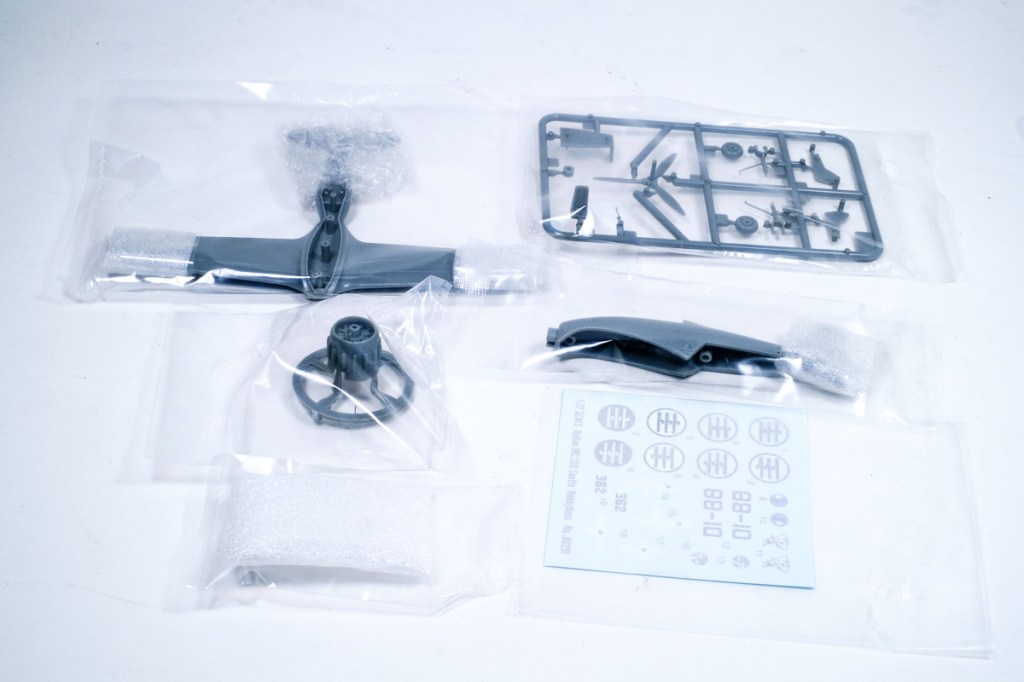
Note the circular sprue ring around the engine housing. A simple, but sufficiently detailed casting and an interesting way to achieve it.
The actual airplane did not attract me as such – I bypassed this kit for several months before buying it on a whim. I should have more of those whims – it is proving to be fascinating. I think the only reason I took it off the shelf was the thought that I did not yet have an Italian plane in Stein’s Air World. Of course, come to that, I don’t have a German one in there either. The thought of the dotted green and sand camouflage was the intriguing part – I’d recently read an article on free-brushing this sort of thing with card masks and I needed a paint mule for it.
The net showed most of the Macchi C-200’s with a green chromate interior, and as there was little enough in this cockpit, it went on with a brush very easily. I also attached the canopy before masking it to provide a paint seal and to give more of a hand-hold for the little tape bits. Only the side windows needed the Micro mask application. But what an oddity with the semi-open canopy. What were the Italians thinking?
That thought also occurred to me as I saw the profile of the fuselage and the distinct droop to the forward nose section. The engine, of course, was small, and I daresay that limited the usefulness of the design…but it was not until I saw an Internet photo of a preserved example that I realised how good it actually was for the pilot. Sitting there on the tarmac he had a full view out of the side of the canopy past the engine in the direction he was travelling – he could taxi without needing wing riders to steer him away from other traffic. Bet the P-47 pilots would have liked something like that…though they benefitted from a big US engine once in the air.
But you cannot have all things in all designs. And so I found out with the first of the painting…
 The Little World
Leave a comment