
The usual procedure for my painting of camouflaged aircraft up until now has been:
a. Smooth and fill seams and make the basic airframe ready. Prime with a Tamiya spray can.
b. Paint the solid underside colour.
c. Cover this with tape and occasionally with Maskol.
d. Paint the lighter of the top colours.
e. Make a mask of paper, tinfoil, silly putty, or tape for the top surface.
f. Spray the darker colour.
g. Strip and trim after all is set.
h. Gloss coat.
i. Decal.
j. Satin coat.
There’ve been variations, of course, and I’ve done them to see whether or not they are useful…this seems the best sequence and choice of materials. But the Italian fighter scheme has added one more twist.
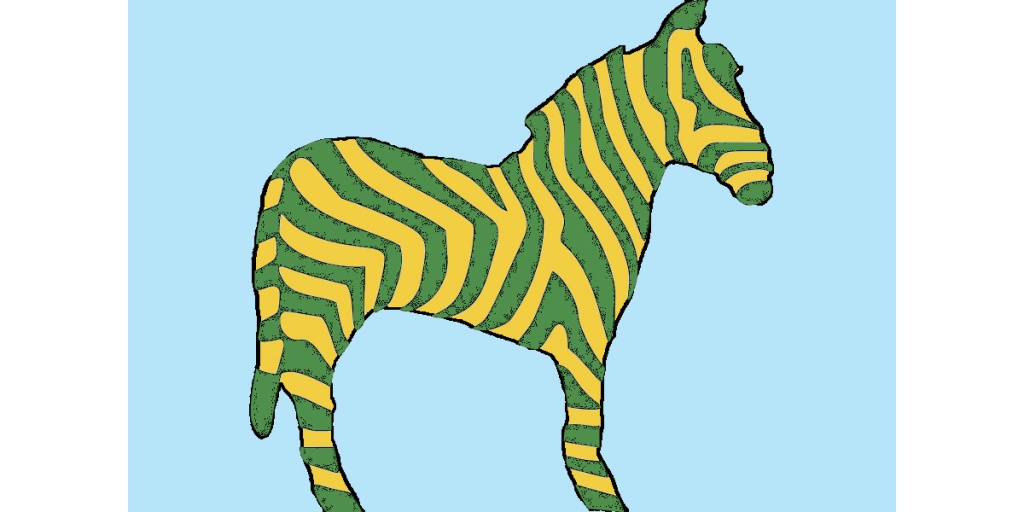
The colour drawing as and internet reference photos show Italian planes of the time with a yellow sand base colour overtopped with a dark green reticulation. Or perhaps a dark green overall with yellow sand patches set at short intervals. I really cannot decide whether this zebra is a white horse with black stripes or a black horse with white stripes. The box art model tries to do it with green under and sand over…but their sand spray over is a little weak.
My first experiment is to do it their way. I ran Tamiya dark green over a grey primer and cured it in the warm air box for several hours. Then I dialled down the acrylic airbrush to a very small pattern and started to do the yellow spots.
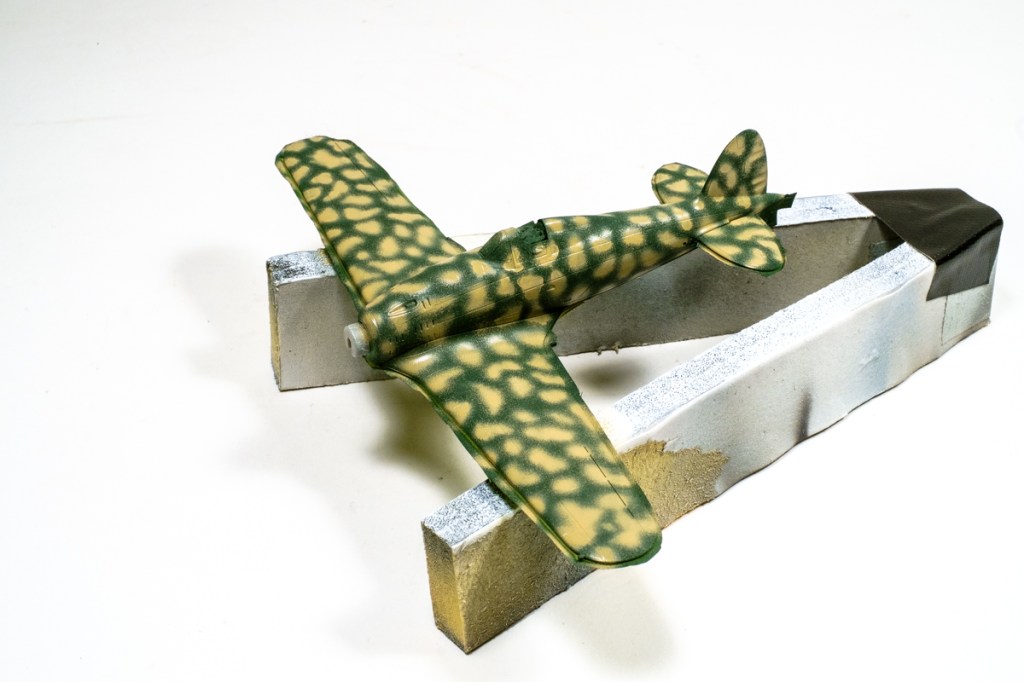
The article that advocated a card mask for this sort of work was good, but the pattern with that method was not tight or random enough. I settled to the task under close observation and a low pressure, clearing the needle of dried paint frequently. After the overall spots were on I then went over them again to deepen the yellow sand colour. The final coat of satin will even out the disparity between the reflectivity of the green and the sand.

I am pleased with the result so far and will finish the rest as per usual. But the next part of the experiment will be the clincher – I’m going to hunt out another small Italian plane of the same era – a different type, perhaps – and try putting the sand yellow on first with a network of green lines over that to break it up. Then I’ll compare the two methods. I may even cut a bunch of small masks from a clear tape product to leave hard-edge spots.
Of course this sort of technical experimentation means buying more model aircraft…but you have to be willing to undertake these sacrifices for the sake of art…I’m a martyr that way.
 The Little World
Leave a comment