
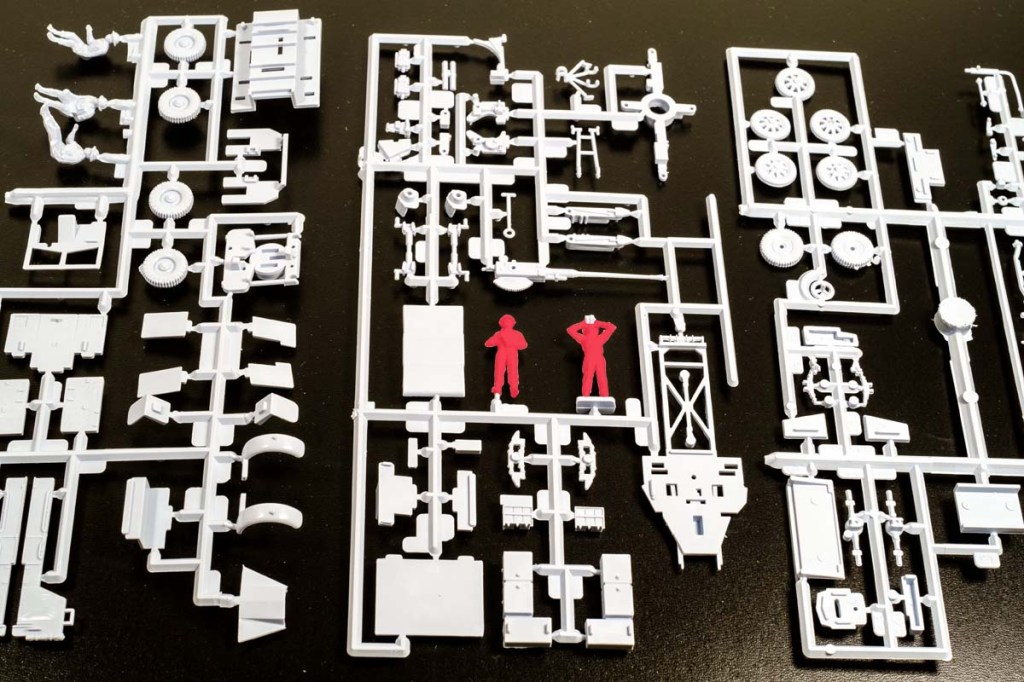
Scale modelling has many surprises – not the least of which are the prices of the after-market accessory packs. But even if you do not go that far, there are still discoveries to be made:
a. The size of things. Here one must have some sort of yardstick to measure what is seen in the box when the kit is opened – or metric ruler, as it happens in Australia. of course you can have scale rulers, real rulers, and plans to hand, but nothing lets you appreciate what you are seeing better than other things of the same scale that you are familiar with.
The OO or HO enthusiast who contemplates a freight car, locomotive, or structure is well advised to look at a similarly scaled model car or truck – something they might see on the road right now. Then they’ll know if they have something that fits their Little World. Too often they might see a picture of the object but not know the real size.
I have just had this experience when opening a box containing the parts for a Douglas DC-3/C-47/Dakota in 1:72 scale. I am sure the manufacturer was accurate with the measurements, but what a surprise to see how big the aircraft is! I’ve been building British twin-engined bombers for the last few months and this is enormously larger than they are. Makes me nervous to consider a DC 4 or DC 6 in the same scale.
A similar surprise went the other way when I built the Douglas Nomad in RCAF colours. Tiny.
b. The shape of things. Look though you might at photos, drawings, and YouTube videos of anything, the actual object in hand has planes and crevices, junctions and mountings that you hardly ever appreciate. Only the 3D of the solid item brings them home to you. One always has to realise that the makers of anything can get it wrong as well as right.
c. The weight distribution. You never appreciate how heavy an engine is, nor how it can affect the centre of gravity of any vehicle, until you find that a plastic one does not keep the nose wheel of a model on the ground. Then you’ve got the problem of finding how you might put weight in the front to do this. Some models have very visible interiors and very little place to hold weight.
d. The rarity of something. Okay…you’ve got one, and so does everyone else who bought the kit…but it comes as a shock when you realise that only one of the things was ever built, and there is no room for latitude in how you build it. You find that your model is the same as everyone else’s and it’s only the details that differentiate you.
e. The potential difficulties in reproducing the markings and colour scheme. Some car and plane builders had a standard scheme that was made for economy – they can be represented with a similar economy of effort.
Some had way too much time and paint on their hands and you are going to have to work like a decalled dog to get any believable representation of the prototype. Full-size commemorative and display team vehicles are the worst – multi-surface decals that need to be pieced together from a jigsaw puzzle of panels, and frequently onto insanely compound curves.
f. The questionable variations of the real things – questionable in both form and usage. I know that standard vehicles were modified in the field to do things, but I wonder at some of the models presented. Also at some of the so-called captured and repainted items.
 The Little World
Leave a comment