
I cannot think of a worse way to approach the business of being a scale modeller than that of a production line worker with a contract to produce a product in a set time. This also applies to the full-size workers who made the full-size airplanes – Some were employed and some were drafted and some were kept in slavery. I wish to avoid all three states.
But it is not easy. As soon as you start to do things you have two pathways to go down; you can become all arty and bohemian and lackadaisical or you can become efficient and innovative and streamline your work. Both are echoes of real-life behaviour and who wants to be real in the modelling life? We can be unhappy at 1:1 and don’t need to reduce the scale.
But…there is always the challenge to do it better. And we can all have fun with that.
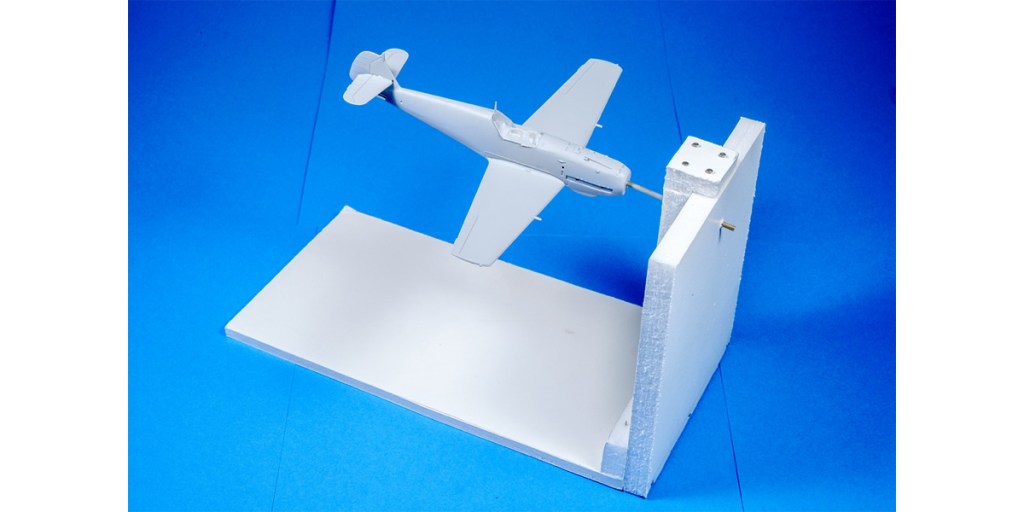
Here is my lesson learned with the Messerschmitt and the previous build – the Hurricane. The lesson is ” Keep The Fingers Off “. And I have taken a hint from war-time photographs of airplane factories in California with this latest gadget. It is the plane jig.
Now, you’ve seen the plane support made of two pieces of foam-core strip. it is still used for many rigging and painting tasked in the Little Workshop. But it is a two-step process – you do whatever you are going to do on one side of the plane and then have to wait until it dries to do the same thing to the other side.
The airplane factories in California had to work on engines and other components and do things to the engines in all sorts of places – so they invented jigs that could turn the engines completely over while still allowing them to be wheeled down an assembly line. I’ve taken this as inspiration for a fighter-plane jig.
Most of the models I get have a hole in the front of the engine casing for a propeller shaft. This hole can support the entire aircraft if you get a tight-fitting piece of tubing in there. And then you can revolve the plane from top to bottom for each coat of paint. If you are doing a base coat or top varnish you do not need to do it in two hits.

Plus the jig suspends the model in the warm air box for curing without any points of contact. I got top, bottom and gloss coat on the Messerschmitt in one day and hope to decal at the mid-part of the evening. I am not constructing fighters for the defence of the Reich here, but I do appreciate the increased ease of working.
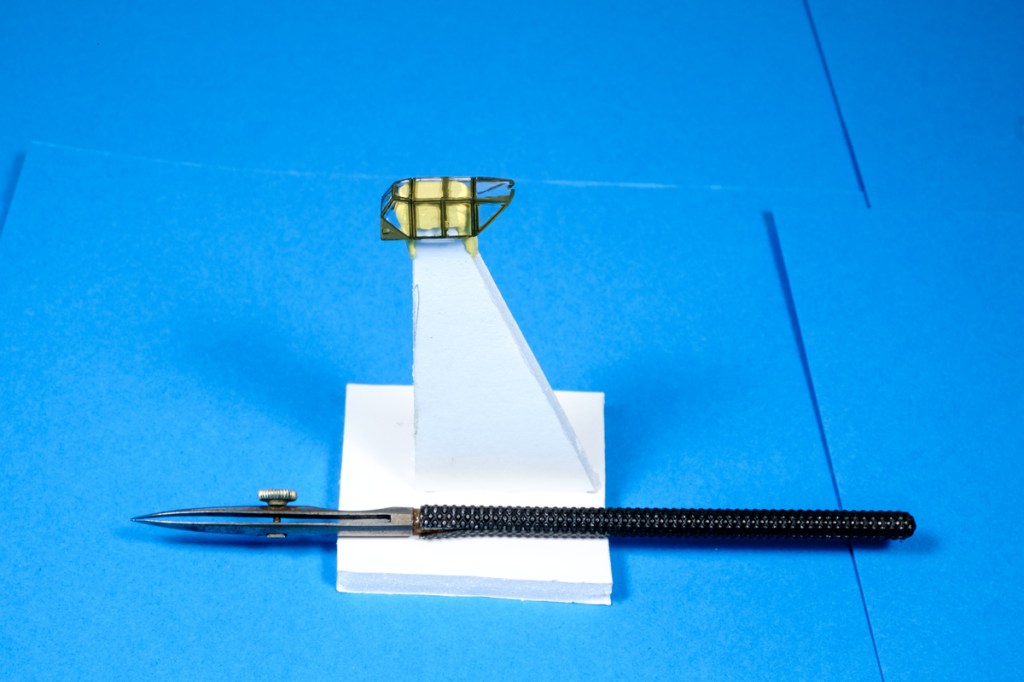
Finally, I have concluded that the bow pen – here one of my Grandfather’s legacy items – is my best chance of painting canopy frames without going mad. And a suitable jig to hold the part makes all the difference.
Note: I see from my WordPress dashboard that I published Part Five of the Messerschmitt tale before Part Four – the curse of a fragmented drafts list. Please accept my apologies, and it will happen again…
 The Little World
Leave a comment