
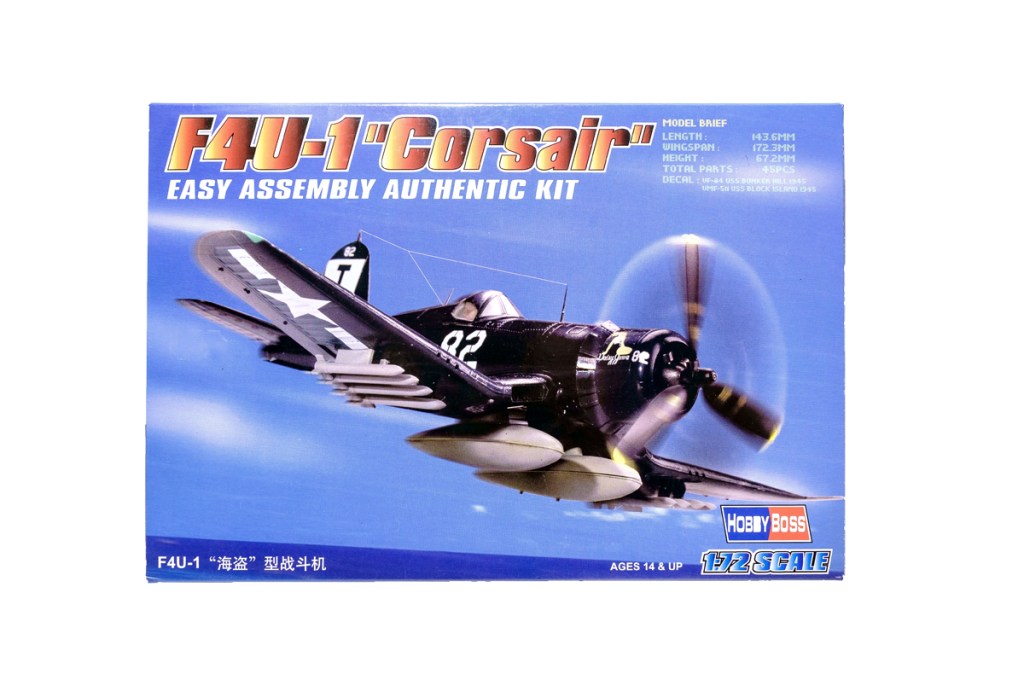
As you’ll have seen from my earlier postings, this kit build is a confidence-building exercise occasioned by a recent failure. It is the second Corsair to get on the deck but this time it will fly.
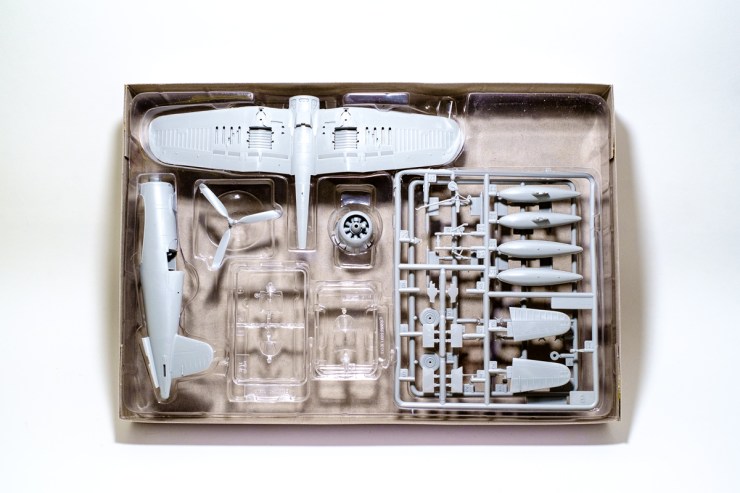
The Hobby Boss presentation is familiar – a clear plastic tray that corrals all the sprues and parts. I note that this model of the Corsair wears a three-bladed prop instead of the four-bladed one of its ill-fated predecessor. I have preserved that prop as a spare part and will research whether the four paddles were ever used on this model of the plane.
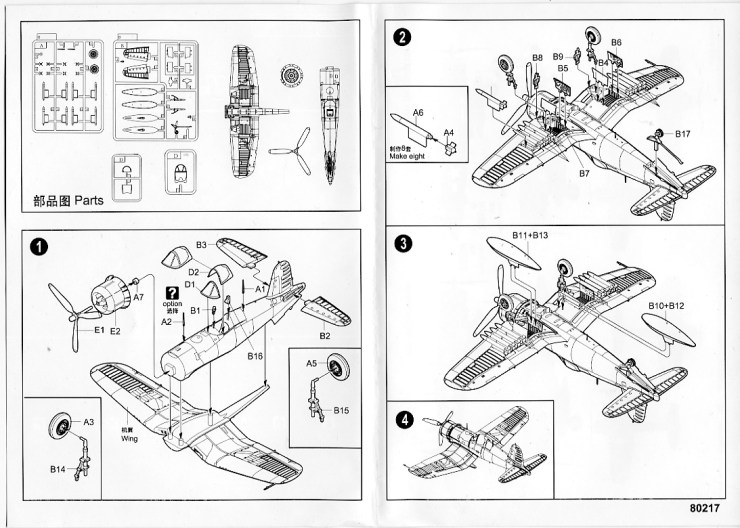
There is nothing to cavil about with a Hobby Boss product – the castings are precise and fit well, and the fact that dihedral and tailset are pretty well click-in makes for a whole lot better feeling at cement time. I am proud of the Little Workshop jigs that get theses angles right…when they are right…but I know well that there are some tails that have not set perfectly. I have not been tempted to saw them off and re-glue them, but it has encouraged me to be more mechanical and geometrical in the future.

I am particularly impressed with the complexity of the cooling flaps on the cowl – very few of the makers will give you the option to spread them wide open on the tarmac or deck. The engine has just enough detail to look good if it is a dark grey shadow in the deep cowling. The overall spray of the plane will actually do this without any especial painting.

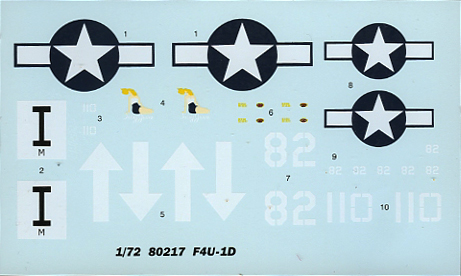
Rockets? Well I am not sure how many Navy planes took off with them, but as HB have provided such a nice set, and with such defined fins, I will add them. The slots in the wing are prominent anyway and need something to fill them in. Fortunately the decals do not foul the mountings.
These days I am paying more attention to box art and colour scheme sheets. I note that HB have two different ideas about the colour of the basic aircraft – one is a midnight Blue and one a Deck Blue…and the drop tanks are different colours between box and sheet. Also, the rockets are undifferentiated objects. Fortunately there are clear Google colour pictures of the real things in place under wings and they are not hard to duplicate.
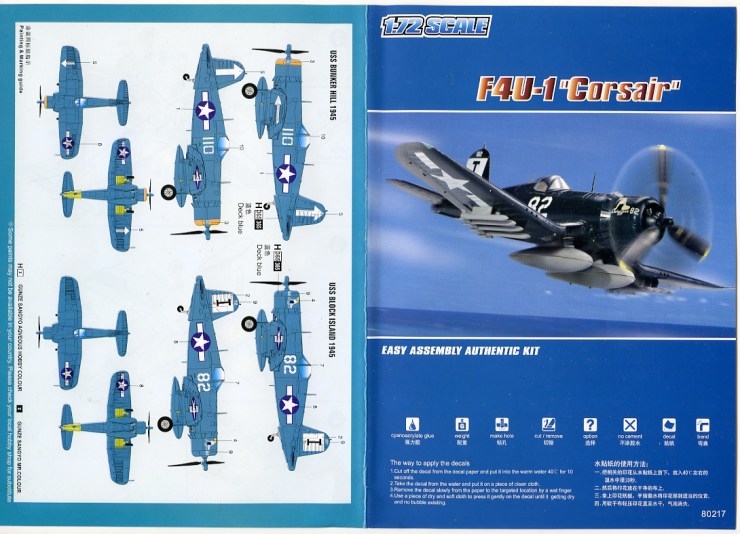
Experts and the fussy may decry the practice of building the model out of the box, but I figure that if the makers have done enough research and provided an ensemble that works, I would be silly not to make use of the chance. My Air World museum can be home to all sorts of aircraft. The US Navy decals are straightforward but I don’t know yet which livery I will pick.
 The Little World
Leave a comment