
There really should not be any basic problem with an Airfix kit – even the historic ones with their rivets and misshapen crew members are moulded to eventually yield a representation of whatever is on the front of the box. If you are diligent you can end up with just this. It may have some inaccuracies occasioned in the drafting or moulding, but that is not your fault. And no matter how wrong some styrene troll from Wolverhampton with a scale ruler thinks it, it will look like whatever it purports to be.
There should also not be a problem with a Spitfire. They were not one-offs or rare in the RAF. Okay, there were a number of variants and no end of service adaptations from time to time, but the basic Spit is in there under all the mods. You cannot mistake it.
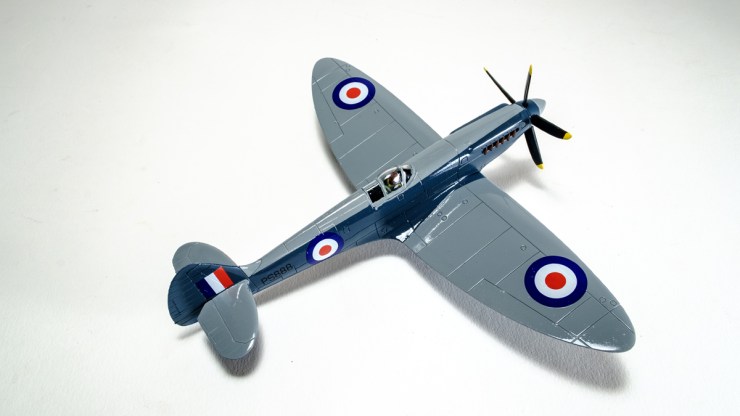
This Mk XIX is not a fighter – it is a warplane that plays hide and seek and then runs away. A sleek and polished Peeping Tom. The oblique and vertical camera ports give it away, as does the gloss finish and clean blue-grey underside. No roundels to attract attention.
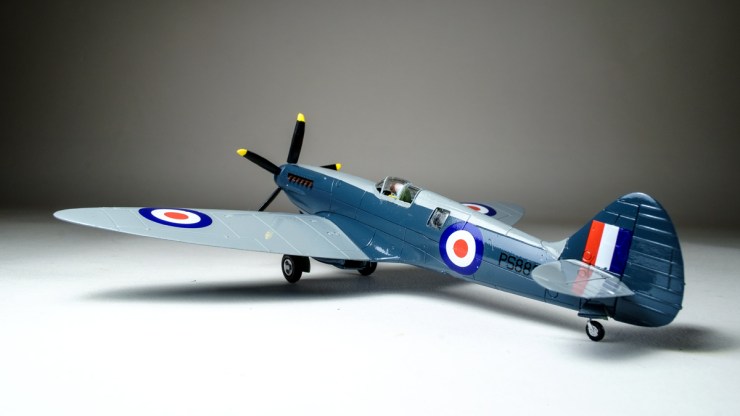
It has proved to be a perfect diversion for a week and a testbed to prove that the Mr. Hobby Clear is the fluid of choice for shiny finishes. It was used to convert Tamiya RAF Blue and Medium Sea Gray matt paint finishes to gloss for the decal and then on to a final gloss seal. My only gripe is that it doesn’t seem to be available in bottles larger than 10ml.
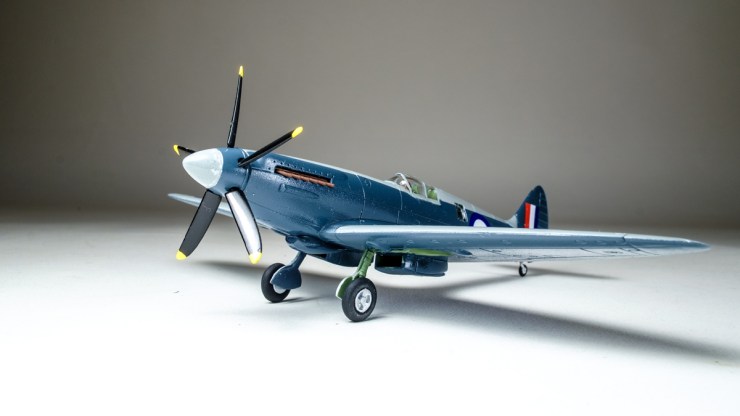
But it works. And I am so charmed by this 1950’s RAF scheme that I am going to search out other examples of early Cold War aircraft to build that may have similar finishes. Of course some of them may be rather duds as far as aircraft go, but that doesn’t stop the modeller – indeed it encourages the Czech small-batch makers all the more.
 The Little World
Leave a comment