
And is damned proud of it, at his age.
Now back to the Little Workshop. All junk is not junk. Some junk is junque – witness the sort of things that twee secondhand shops import from Pakistan and sell as genuine. Junque indeed.
Some junk is material that is just resting between engagements. The box of gears and old hinges that has been on the shelf for 35 + years and suddenly yields the exact thing that you need for your model is an example of this.
Some junk is raw material for your next model. Wood collections – cardboard collections, tin, plastic and paper ditto. Keep them sorted, keep them separate, keep them dry, and keep them to hand. Never be afraid to delve.
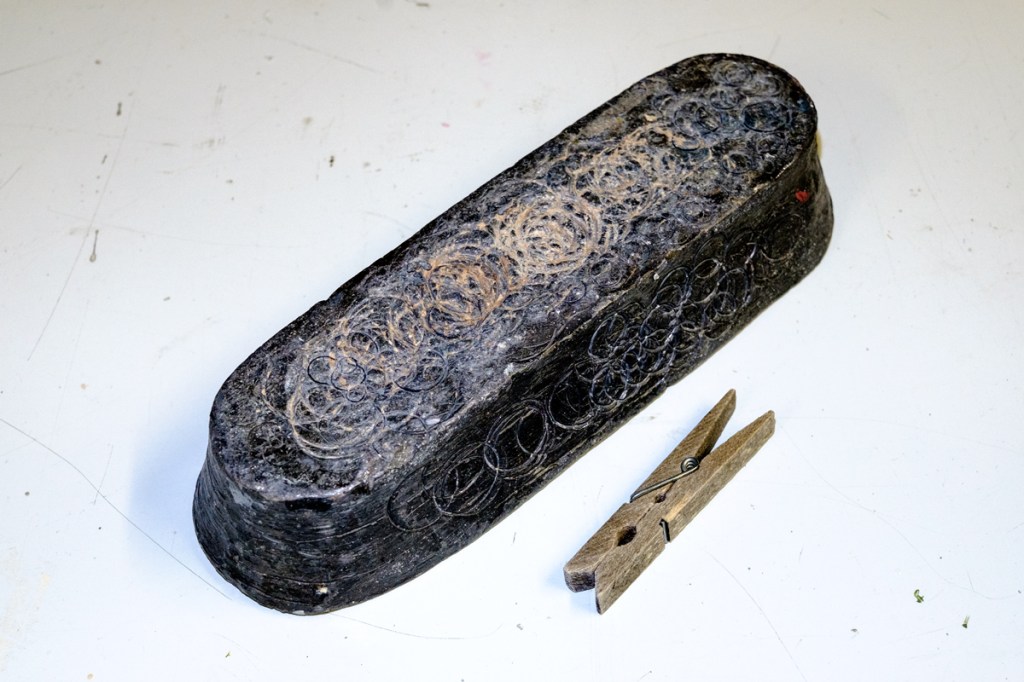
Some junk is actually tool material, did we but realise it. The heading image is one such thing.
It’s an ingot of lead – collected and cast in my muzzle-loading rifle days. Someone must have had a cast-iron ingot mould and there was enough scrap lead and old musket balls to fill it up. God knows what I thought I was going to do with it as it would have been nearly impossible to remelt…but in the meantime it has been one of the most useful items in my shop.
It is tremendously heavy and has acted as a setting weight for no end of glued structures. It is a dead anvil for punches or other items that have to penetrate to work. It is a counterweight to stabilise wooden sheets as they are sawn into strips. I would not be without it.
The opposite of the dead anvil is a live one – and really big ones can be quite expensive. A modeller needs one too, but with a smaller surface area. I went out to our local railway the night before the big derailment and sawed this section out of the main east-west line.
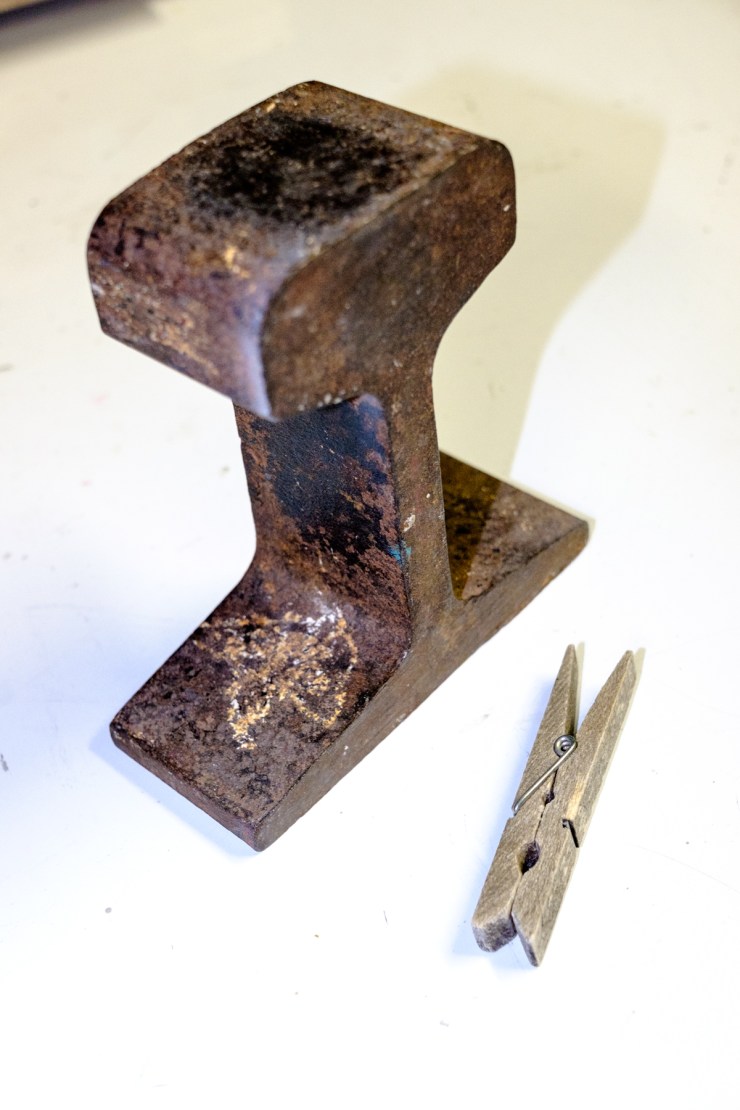
It cheerfully handles riveting, metal shaping, and all sorts of truing operations.

The last bit of junk is the remnant of packing for an air conditioner that was delivered to the house. The rest of the carton was trashed but I kept four of the foam packing shapes on the off-chance that they would be useful. Little did I know.
One of the shapes will eventually be sawn into small parts for occluding fuselage openings in model airplanes. it is impervious to the paints I use and seals the cockpits and window spaces perfectly. The rest will be kept largely intact but carefully trimmed to preserve the sides and ends that are 90º true. Combined with the large whiteboard building surface that I erect structures on, these blocks will act as perfect jigs. They are semi-rigid but won’t scratch the models being built.
 The Little World
Leave a comment