

I have spent the last three days batch processing US Army fighters, attack planes, and bombers. It started as a whim, became an experiment, and is looking to be a darned good technique for the future.
It started with an idea – in my case these may be vast ideas or half-vast ideas, but you never know which until you are down the track a piece. My goal is a display for next year’s WASMex and it needs an aerial convoy passing through my flying field. I researched the types of planes that went through and googled up enough actual photos of the convoys to be sure of the markings. Most carried standard USAAF colour schemes with insignia changes.
I could be specific about the time frame, and chose one with the widest variations seen – I always want to build everything in the shop and there’s no sense limiting yourself to just one team’s colours.
The first decision was to finish the planes to the undercoat stage and store them, pending a mass paint job at a later date. I knew this would risk losing some parts but so far the policy of putting everything back into he original box seems to have worked. I’ve risked seven models – four fighters and three twin-engine ships.
When ready, I sprayed them all with Mr. Color Surfacer 1200 – I like it as well as the Mr. Surfacer 100o that I used before and as long as I make the seams and fillets good, it should be possible to use this finer grade. Really, it’s just a matter of what the shop has in at the time…
Then the lower surface colour. I did succeed in getting enough Mr. Color No.13 Neutral Grey to do the batch easily and there is plenty left over for the next production run. There is little subtlety about this – it can all be sprayed when thinned through a .05 trigger gun and as long as you get it far enough up the sides of the fuselage you are fine. Pays to study the pictures, however, as there was quite a variation on the ” tide mark ” for the Army ships. And many of them used a wavey demarkation line. With the twin-engine jobs you might as well spray the inboard surface of the nacelles and mask out later for the Olive Drab.
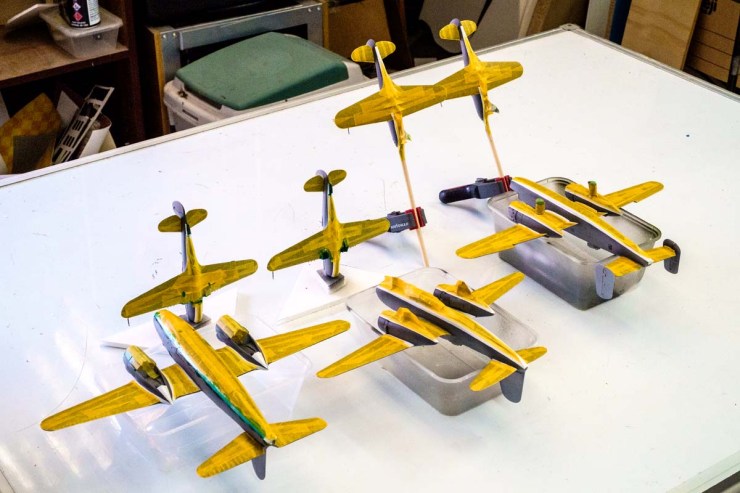
Well, I was patient. I waited overnight for the NG to cure before I essayed to mask it. The masking took a day and a half in the Little Workshop. Fortunately I have a good stock of small masking tapes as this is the sort of job that uses it up. Also fortunately there are a couple of tricks you can use to make the job easier:
- When there is a complex surface to blank off you can stop short with the tapes and just coat it with one of the commercial masking solutions. I am currently using Mr. Masking Sol R and loving it. For windows I use Micro Mask.
- Free plastic foam from a number of sources can fill wheel wells and cockpits, but then so can cotton wool balls. Stuff it in there and then run the Mr. Masking Sol R over the surface and it is perfectly sealed.
- Don’t be afraid to mix Tamiya flexible tape with Ustar rigid tape.
- For the wavy demarkation line set out a straight or curved Tamiya tape and then use the liquid mask to make a wavy top margin. Saves you a bundle in rubber solution.
The masking took a day and a half, but if you are doing more than one particular prototype you find that you get very much better on the second and subsequent planes. It also helps if you mask in a symmetrical pattern. You can get the lines looking far better if you build up from right and left at the same time, rather than just finish one side and then try to match it.
Once masked, it is as well to spray quickly before the adhesives in the masking tapes let loose. I used to put the masked plane in the warm box prior ro spraying but this caused many of the tape seams to soften and open up. Now it is up and into the spray booth as soon as convenient.
Finally – un mask as soon as you decently can. If you leave any tape too long you risk it becoming a nuisance and gluing too firmly or leaving residue. Now I unpeel the models as soon as I am certain the second coat has set. This is a better deal when you use solvent-based acrylics than either the aqueous ones or the enamels. You get a fast turn-around time.
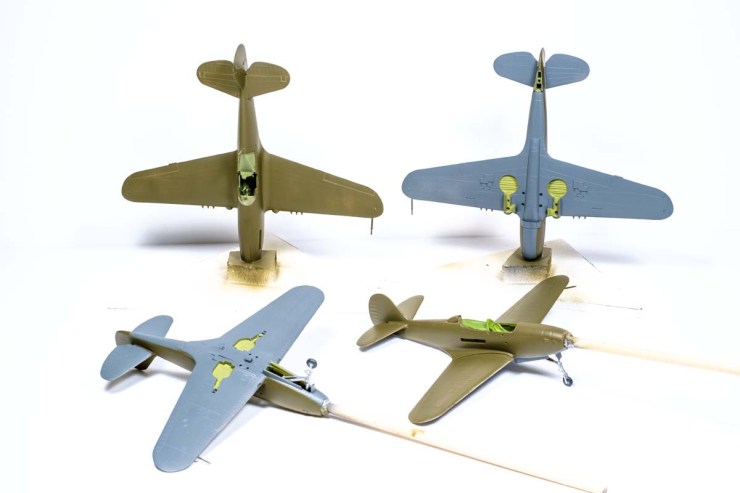


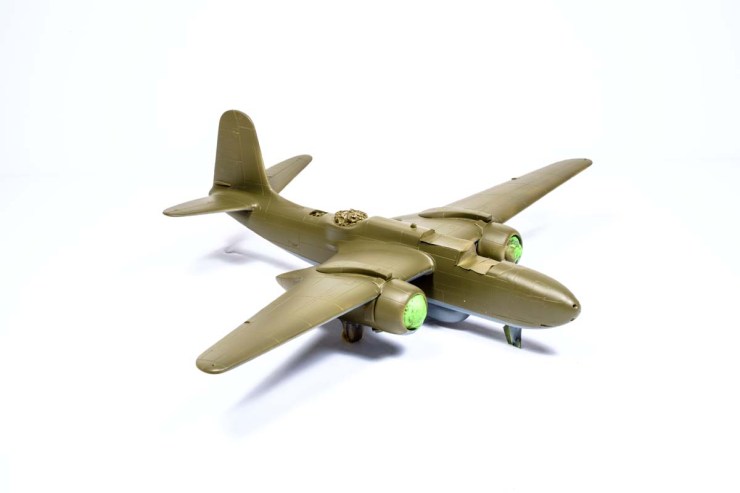
* It all went well today, but when it all goes pear-shaped it is known as Son Of A Batch processing…
 The Little World
Leave a comment