
I settled into a pleasant routine of an day – since the weather has turned hot I have decided to adjourn at 1:00 PM to the indoor modelling desk and complete small tasks. If these are brush painting or cementing jobs I can do them in comfort – the Little Computer room has an air conditioner. This’ll be much the case when the Western Australian winter hits, as well, except the time will change – i’ll be inside in the night and out in the Little Workshop in the day.
But you can only do so much on any one kit before you want to adjourn to the spray booth, and this is outside. So I need a new task to do. I generally reach over to the stash and draw one forth. In this case it was the Airfix F-86 E that will become the Canadian fighter.
Remember I mentioned that it was easier and more efficient when you approach a kit for the second time? I certainly found this out with the Airfix Bolingbroke I modelled as a Coastal Command plane and it is even more evident with the Airfix Sabre.
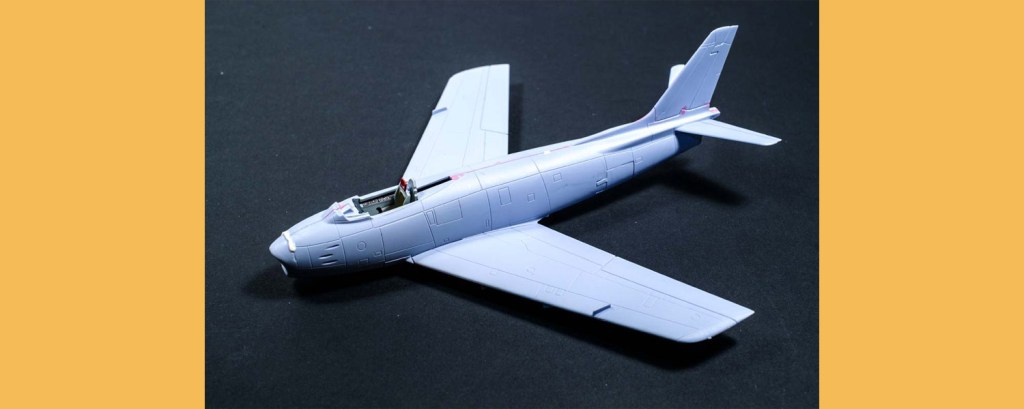
Admittedly, it is a good new-issue kit, and there is little fettling needed to get a good dry fit – but even so I was surprised to discover that I had essentially popped up out of the hole on the second evening with the kit in flying condition ( albeit a little windy without the canopy…). The saga is not as long as the one that Phil Flory tells about his contract to build variants of the F-18 fighter – over 300 models – but I must say I was not bored or annoyed at all to be re-visiting the kit.
And look how little puttying was needed.
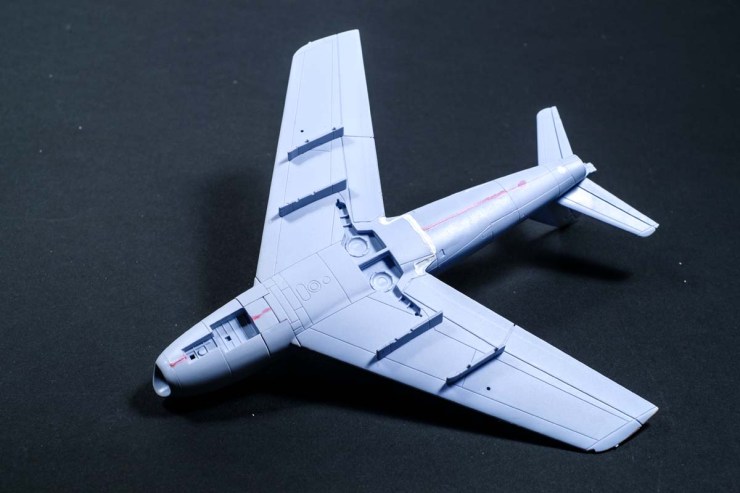
I have three different strengths of filler – I suppose for three different scenarios – and you just squirt or wipe them on with a spatula. I’ve learned the trick of quickly smoothing them with a dampened cotton bud as well, and the clean-up sanding takes no time at all.
Still not entirely decided whether painting wheel wells before or after the main scheme is the best way.
 The Little World
Leave a comment