
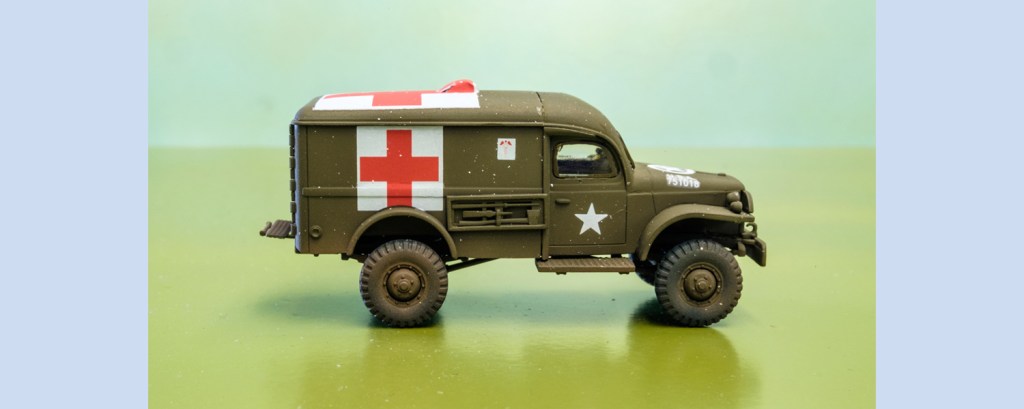
Everyone has a sort of a bugbear in their modelling. One person will have no luck with paints. Another will continually mess up clear parts. In my case it is vehicles – I never complete one without some basic flaw.
In many cases it is the basic structure that foxes me. 1:72 and 1:76 vehicle kits can be made with a remarkable number of parts – far more subdivision than would be strictly necessary to make a display model. I guess it goes back to the Airfix OO and HO vehicles and tanks of the 1960’s. They were a wonder of tiny parts -even more complex than the aircraft – and spawned a whole sub-division of the hobby making ” funnies ” and modifications. Good value modelling, as they were as cheap as chips but took a long time to complete.
Well, I build ’em – ambulances and utility vehicles and oil tankers and such, but I’m damned if any of the sit square on the ground. By the time the tiny frames are mated with the tiny cabs and backs there is always a skew that means one tyre is up in the air. I have become philosophical about it and were I to use them as wargame vehicles I would mount each one on a rough base to disguise it. As it is, I just photoshop out the worst of the errors.
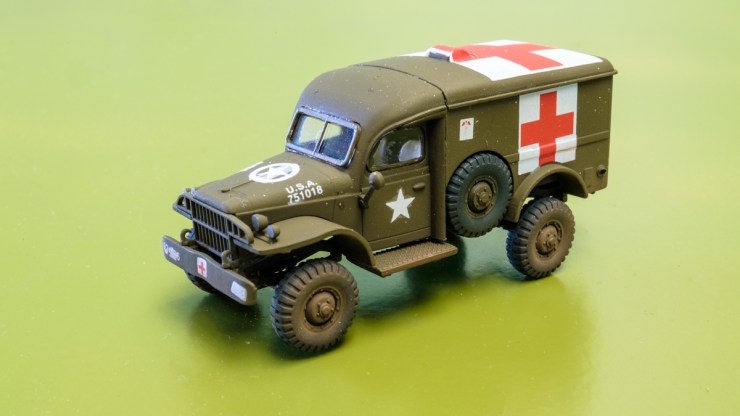
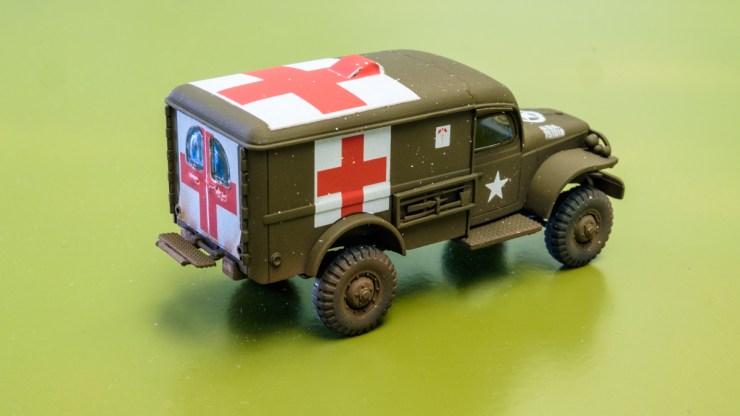
This army ambulance was a delight to build as long as I accepted the fact that three of the four tyres were going to hit the tabletop. The glazing went in a treat and even the ambitious decal sort of fitted in the end. Academy decals are robust things and you really need to be able to hit them with a lot of solvents under ideal conditions to master them. I painted the thing with semigloss, then flatted it all after the decals were on and blew some dust up under the chassis and wheels to dirty it up.
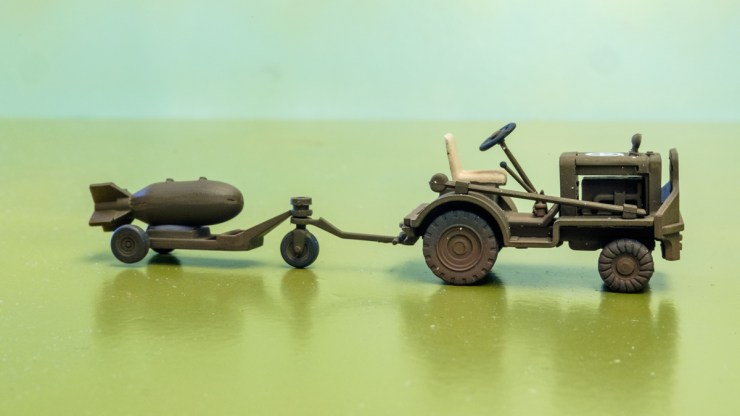
The bomb tractor was more successful, and I am going to see if I can find more on their own to make into USN deck trolleys. The instruction sheet offered the idea that it could be painted yellow so that’s the next plan.
 The Little World
Leave a comment