

Do not adjust your set or your eyes. The green is supposed to look like that.
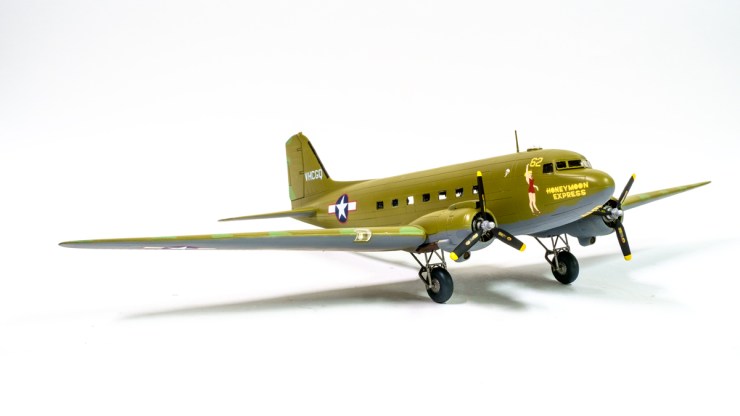
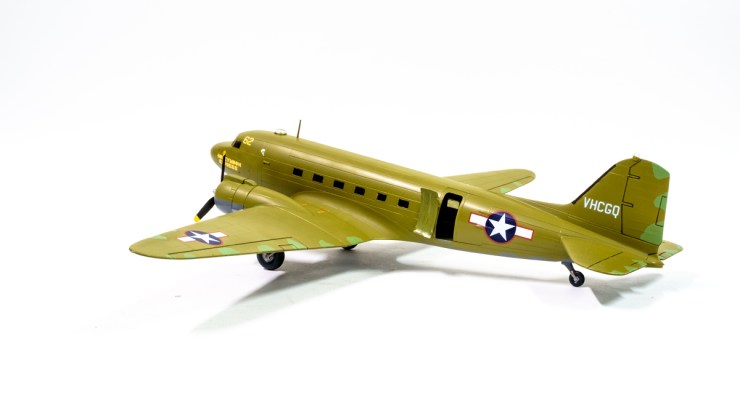
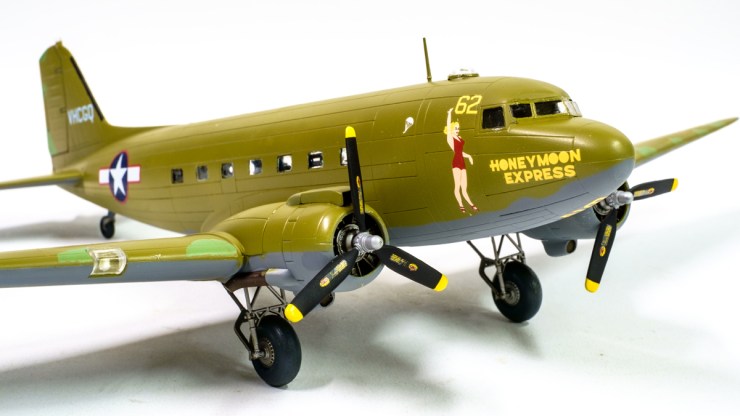
VH – CGQ or ” Honeymoon Express ” was a lot dirtier in her flying days than she appears in the museum. Not a scrap of shine on her in the three photos that appear on the net. I sort of chickened out on flooding the final finish with Testor’s Dullcote and you can descry a little sheen here and there. But overall I am very pleased with the result.
The build was uneventful as far as disasters go – a misplaced antenna that needed re-mounting was all that slowed things. But I did learn a new skill as I worked – I outlined the gaps between the control surfaces with a thinned wash mixture to make them stand out – the first tentative steps to weathering something. the venture was suggested by looking at the Ustar equipment site and noting that they sell what looks like an old-fashioned nib pen for dripping in washes and panel lines.
I wasn’t about to buy another tool, but a fossick into the old surgery desk drawer brought forth a perfectly good nib pen with a fresh point. Glory be…it worked as planned and was not so overwhelming as those techniques where you flood a paint surface with oil or thin mud and then try to wipe it off later. I encountered one of these models today as I was doing photos at the club and the powder pigment was real pain. It was the last thing in the world that I would ever want to get onto a camera.
Anyway, the Honeymoon Express decals went on perfectly with the aid of Mr. Mark Setter. This is proving so good that I may give my bottles of Micro Set and Micro Sol to the club and just continue with the GSI Creos products. Left to itself it snugs the toughest film down into the panel line.
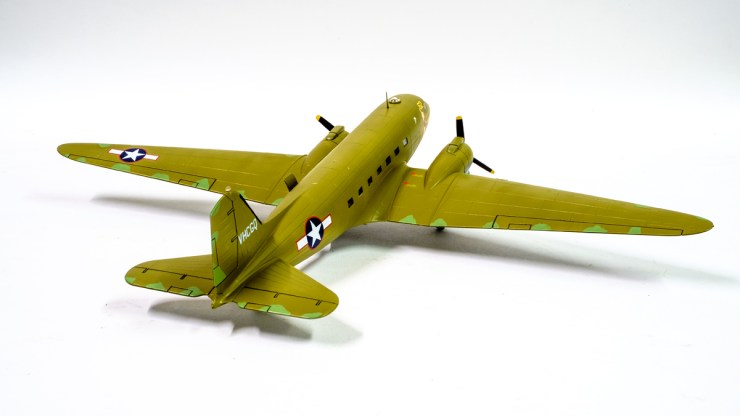
Now that green thing. Note the leading edges of the wing and its trailing edge as well as those of the tail empennage. Those irregular mid-green splotches are copied faithfully from the accurate decal call-out sheet. But they are the most puzzling of camouflage ideas – they do not break the tail or wing outline sufficiently to mask anything and are not of such a contrast as to fool any eye. Yet I see this sort of a pattern on a lot of Pacific and SEAC planes. I’ve even seen it on an RCAF Tomahawk based in British Columbia. Who thought to bother, and why?
 The Little World
Leave a comment