
Is a good day. The something you learn may be of great or small import, but the fact that it is now your possession is wonderful.
Today I made use of Ivan Seryy it find out whether or not a scheme for camouflage painting was viable.
The idea of being able to make soft-edge masks for model aircraft has been exercising my mind. I can get hard-edge ones with masking tape and this is no problem at all. Some schemes call for this sort of design and I just reach for the scissors and rolls of tape and away we go.
Soft edges sprayed freehand are also possible – I recently suffered for an afternoon doing just that on a three-toned Israeli scheme. It is lovely but not as lovely as all that. and the work is all nerve-wracking.
The white-tack putty worm and masking tape trick is so far the best result – small soft edges that are quite controllable and very little overspray to spoil the scale effect in 1:72. But they are a complex thing to construct and take time.
I hit upon the idea of using dental wax sheets heated in a flame and curved over the complex shape of aircraft fuselages as a way of getting a slightly thick mask on. I envisaged being able to flame the edge of the mask to form a roll that would act in the same way as the white-tack. So I got out the old dental baseplate wax and bunsen burner and started in. The wax softened well and draped over Ivan like a drunken popsy.
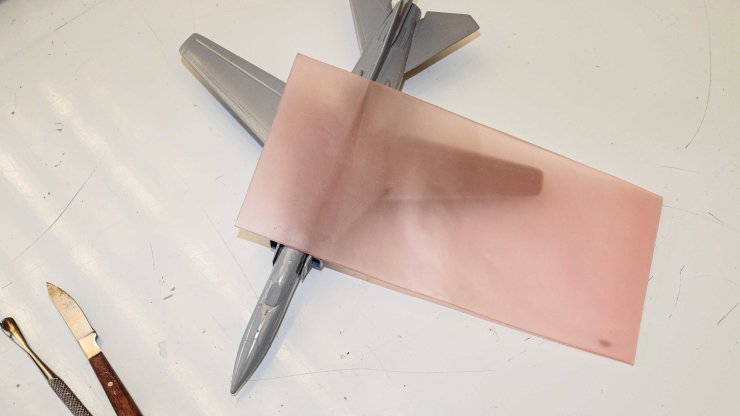
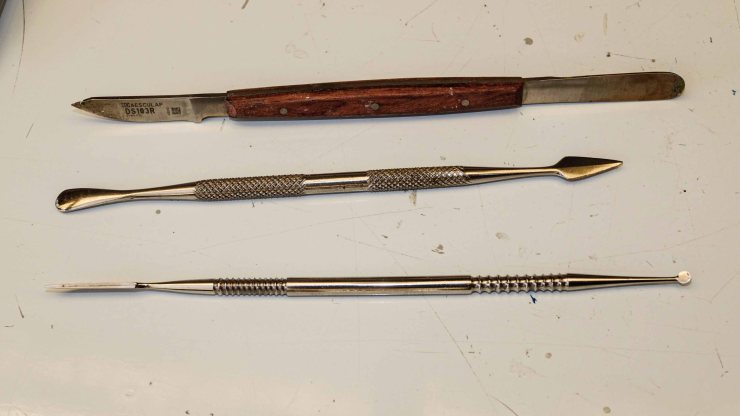
I let it cool and then drew some suitable camouflage shapes on the top surface with the LeCron carver.
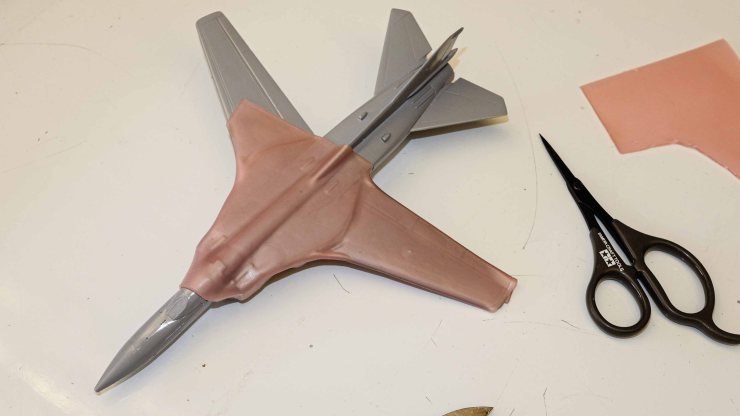
I tried to lever them up from the surface and found the basic problem – the wax sticks far too well to the model. It needs to be scraped clean to come off and this distorts the shape – as well as scoring the model surface. No way of removing and replacing it without damage.
In the dental days this wax was put over plaster models that were wet – it then released with no problem. Here it adheres…and that shoots down the scheme.
Well that was one thing learned. No is as good an answer as yes if it is the truth.


 The Little World
Leave a comment