
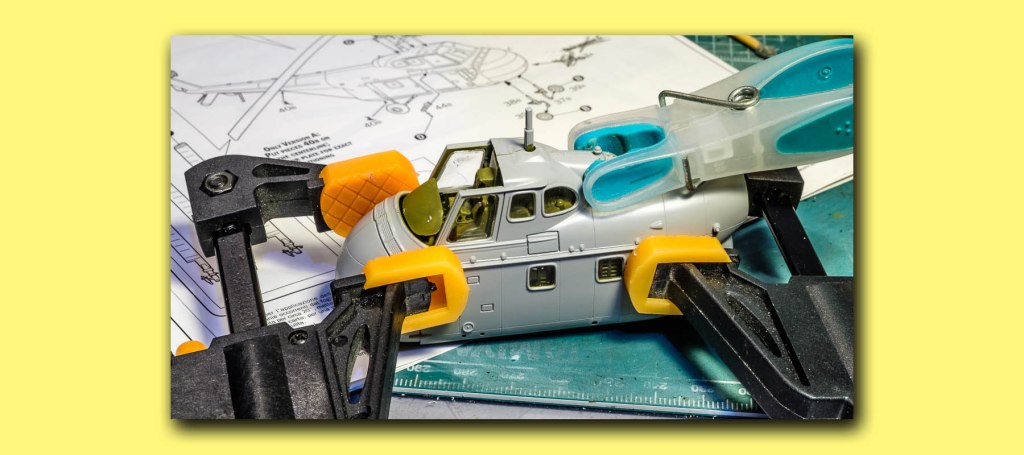
I don’t know if joining the two hull halves is a stressful time for ship modellers.
Listening to the noise from the bench at my scale model club would suggest that it is. I can feel their pain – I experience some of it each time I join two fuselage halves. Depending upon where the model was made, and when, I can either have mild or severe trouble.
Those who have built a short-run kit designed by enthusiasts who wanted to include a plastic cage structure inside the shell will know the drill. Also the saw, the grinding tool, and possibly the hammer and cold chisel. Many difficult decisions will need to be made as to which part lives and which one dies before the two halves will mate correctly. A fatalistic attitude and a certain amount of cruelty will be needed.
Many of your scale model pilots will be badered…
Imagine my pleasant surprise when the complex insides of the H-19 folded into their rightful positions and the fuselage snapped together. I used the precision Bunnings clamps to hold as the cement dried and was rewarded with very little filing and no filling whatsoever.
The windows masked up perfectly with minimal fuss. Note the deeply-cut rectangular panel line – just under tthe two curved windows – one either side. It’s a folding maintenance platform that the crewman stands on to inspect the condition of rotor assembly in pre-flight checks – thanks to the US Army 1958 training film for that one.
 The Little World
Leave a comment