
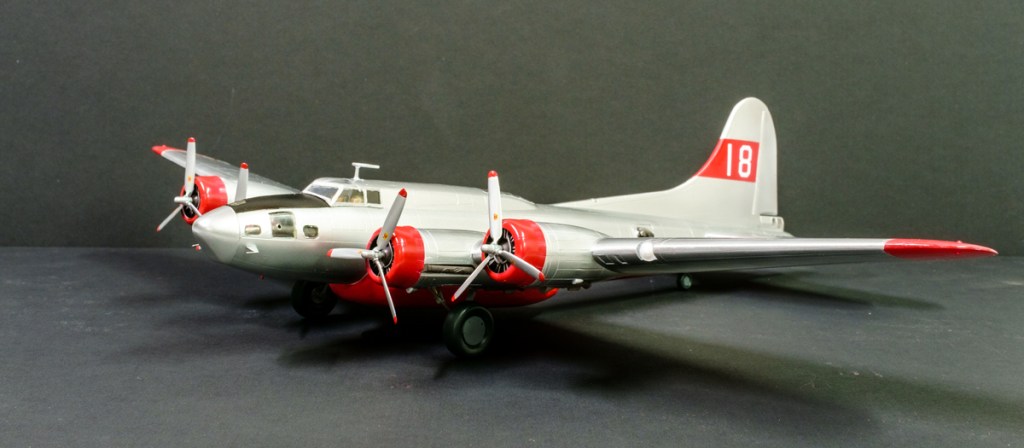
Well, it has been a week. The Fat Lady From Wenatchee is finished and I am delighted – so much so that I will now deliberately seek out other aircraft that can be made into civilian service aircraft.
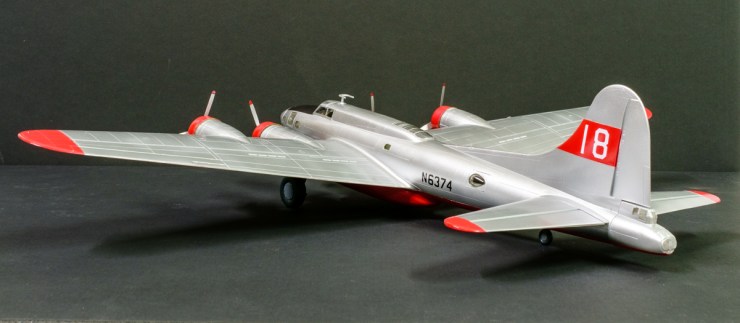
There were severe forest fires in Washington State and British Columbia in the 1970’s and a number of ex-wartime bombers were pressed into service as water carriers. The idea gradually took hold and dedicated Canadair, Douglas, and Boeing planes were produced from later civil or military models to take part in aerial fire retardant drops. I noted on a YouTube clip that there were Lockheed Neptunes and Orions as well as Grumman Tigercats with enormous belly tanks. Even the venerable DC-3 was used. All good fodder for future building.

The trick of masking with the clear canopy worked a treat – once the basic spraying and sealing was done I slid the clear part out and detailed it with the bow pen. No leakage into the cockpit and no painful day of masking.
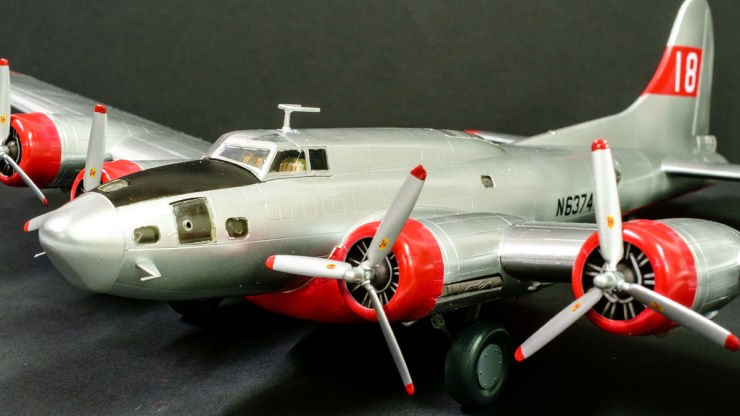
The Academy landing gear is not the best for a Fortress – Airfix was better. There is a discrete brass rod bolstering the plastic strut in there but you’d never know it. I thoroughly applaud the Boeing people for designing an aircraft that needed no landing gear doors – less to cement or lose.

I searched diligently on my selected prototype to see if I could find a company name or other identifier, but all I got was a basic civil registration code on either side of the fuselage. In the absence of anything else, I’ll wait until I can get some more decal printing paper and then make up a logo for the nose.

You can’t see it, but there is exhaust staining under the wings aft of the turbosuperchargers…not a lot, but enough to show the The Fat Lady From Wenatchee is a flier. When I finally finish the nose I’ll consider blowing red retardant spray in a dull coat under the tanks and fuselage. Those things can’t have been that clean.


 The Little World
Leave a reply to Paul Cancel reply