
A day at my model building club is a short one – I get there about 9:00 AM and leave at noon. But I can accomplish a lot in those hours…drink coffee, eat cake, make bad jokes, and cement the first parts of a kit together. The amount of cementation depends to some extent upon the cleanliness of the moulding and the degree to which the kit has been engineered. The Czech kits can be very stick-and block basic so you may not get as much done.
In the case of the AW Whitley the basic Airfix cockpit construction is sound – no PE brass but enough separate parts to make up to a reasonably busy office. The interesting thing is that they have given an option for the co-pilot/navigator. His seat is on a slide rail and can be tracked aft and swivelled to the left to allow him to work on his navdesk. Or – as I have done, you can have the desk folded against the port side and the seat right forward in flying position.
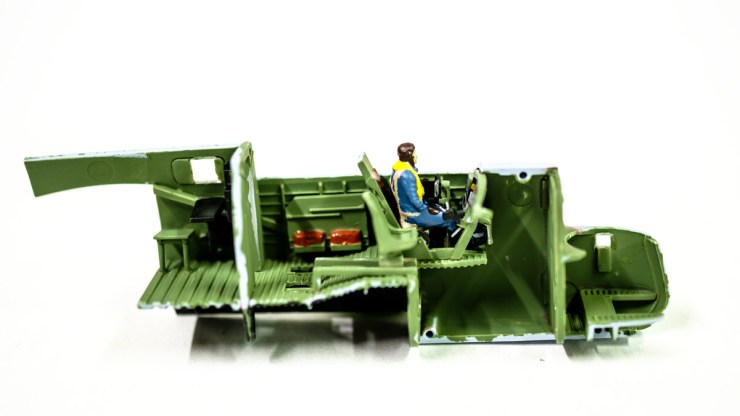
The pilot you see is Uncle Doug. Also known as the Wild Man. I kid you not…
The aft fuselage is three-piece so there will be little seen of the seams. Of course, if you choose the darker camouflage schemes you’ll hardly see anything…I intend to use the coal black then matt it as well. As the heading image shows, the windows are a little agricultural from the inside but you just cannot see in there.
The wing root portion is what I can only describe as a yoke – the wing bottom and top attach from the sides and then the nose and tail clap on.
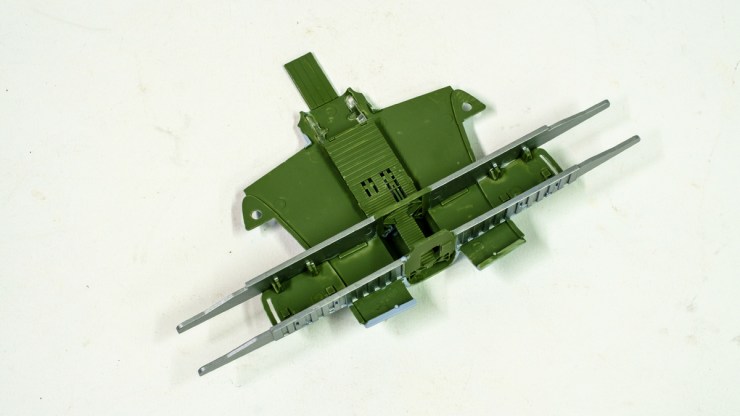
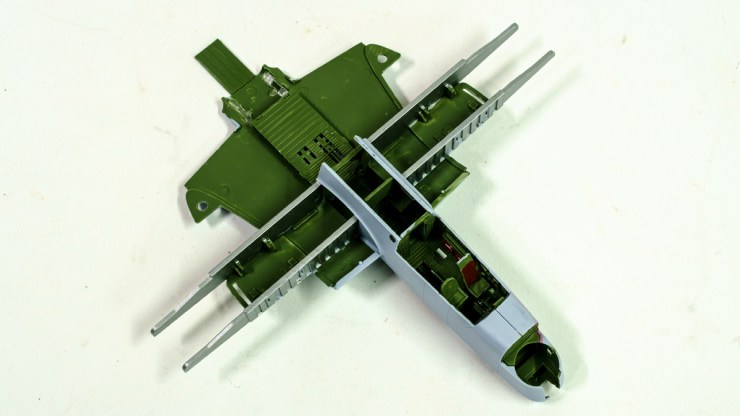

There are adequate lands for the pieces to mate if you are using tube glue – but I intend to snug the lot up and then paint in MEK pipe cement to secure it.
That business of dry assembly and clamping can be quite an exercise. As John said one day at the club – as he walked back and forth with a Sunderland wing and fuselage in hand – you sometimes have no choice but to make use of the biological clamps, as nothing else will provide the combination of pressure and direction to control the plastic. And the minutes needed for the cement to grab stretch to just hours…
I have a number of options here and in my travelling model box – the chief clips are the rubber-jaw clothes pegs that you see on so many modeller’s benches. These are perfect for wing, tails, and other thin parts.

The rubber noses grip on some sloped surfaces…but not all. The clips also exert a considerable pressure and I think I have over-clamped some fuselages in the past. This has led to shifting of the fuselage halves and creation of ridges.
Regular clothes pegs also get used but their range of grip can be limited.
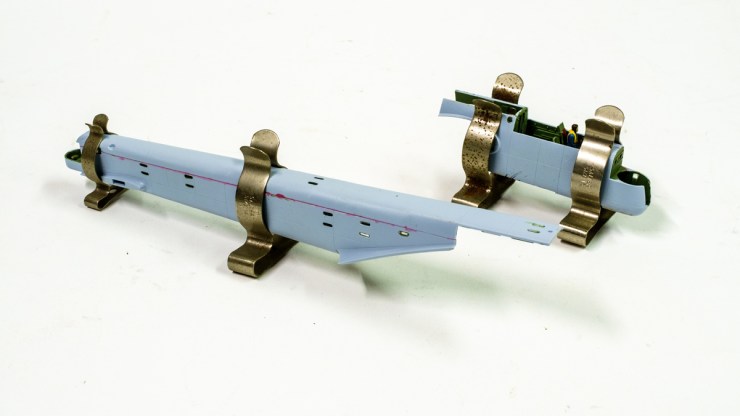
However, the Modeller’s Mind always retains the thought of something that has been seen before…and I reckoned that I had seen something that reminded me of the cross section of a fuselage before. I once had a peg board with clips on it for tools and accessories but took it apart…
So I dug out the clips. Look at this assembly – clean, gentle, and the plastic parts accessible for painting on the MEK. No excess glue running into tape lines. And the clamps cost nothing.


Leave a Reply