
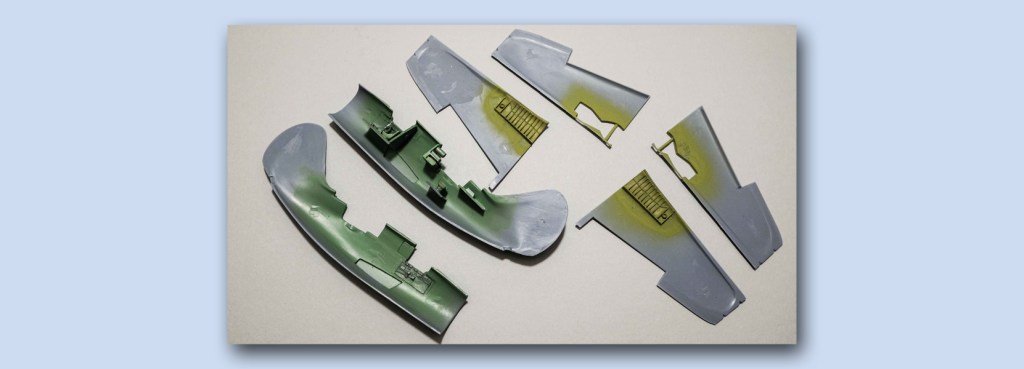
As I have written before – it is the colour of my true love’s cockpit. But it is never the same colour as you see in the books, movies, or museums. It is never the same colour as other people use, and it is never the same colour twice. The only thing that cockpit green ever is consistently is wrong.
Well, what the hell. Or in this case what the Helldiver. I am finally going to assert my independence and paint it the way I think it should be.
Over the years i’ve read a lot of guff about the green cockpit colour vs the chromate colour in WW2 US aircraft. And even more about the USN vs the USAAF. I’ve seen a lot of box art and a few real USN aircraft. The one thing that stuck in my mind was the use of the term ” Apple Green ” for the cockpits and ” Chromate Yellow ” for the rest of the insides.
Then there have been FS numbers and forums and experts fighting each other over the subject and some of the answers they provided seemed far-fetched.
My take on it is to use a green for the cockpit that does come close to Apple Green – at least as close as my memory of a Monogram Wildcat can get it. To my eye the most pleasant choice is a Mr. Color Israeli AF camouflage green. Squirm how you will, that is what I’m going to standardise upon for USN cockpits.
For the rest of the plane’s guts I will use a chromate yellow – both Tamiya and Mr Color do good ready-mades of this and I’ve got at least three pots in store.
For USAAF I’ll choose another, darker green, but I strongly suspect it will end up being whatever my hand falls upon in the green section of the paint rack. A Coolidgian choice, and all the sweeter for it.
And very sweet was this discovery: a way of coping with sloped fuselage sides when it comes time to close the halves together.
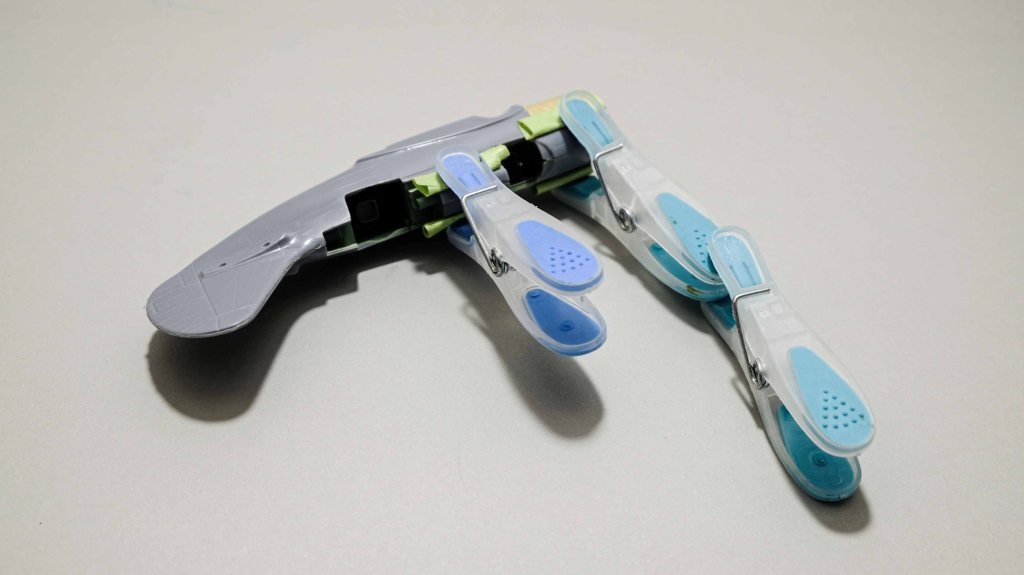
Imagine an aircraft with a sloped fuselage side – this Helldiver in the mid-section – or an ME 262 with its distinctive triangular cross section. You can hold the two fuselage halves together with your fingers to get them to line up ( necessary with vague Czech mouldings ), but you cannot hold them forever as the cement sets.
Your go-to solution – the rubber-jaw clothes peg – doesn’t do the trick. it just slides off and snaps shut. Plastic clamps are just as bad, and if you get big enough hardware store clamp to encircle everything it is in danger of crushing the fit.
Solution is to roll up some cylinders of cheap masking tape with the sticky side out, attach them to the fuselage where you need pressure, and let them capture the force of the clothes peg. They’ll stay put.
If the clothes peg is exerting too much pressure and distorting the joint, capture the handle of it with another peg – that will reduce the grip of the primary jaws to about half their force.
You’re welcome.
 The Little World
Leave a comment