
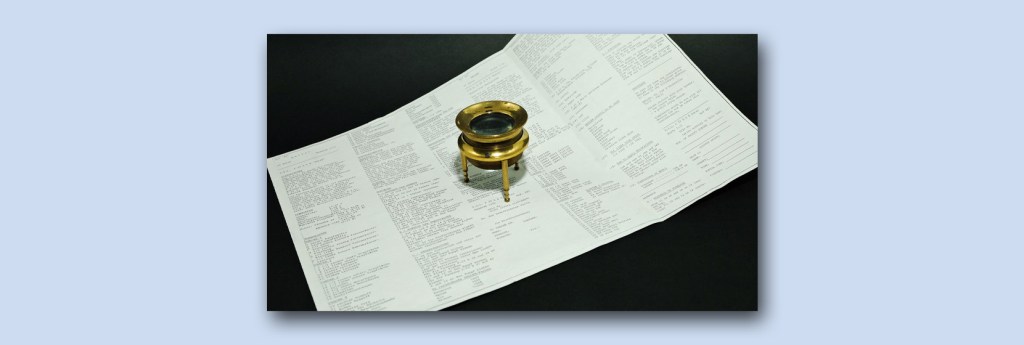
And listening to what it tells you about the rest of the world. Welcome to the classroom.
Every time we approach a foreign land we look first at the language it speaks. If it is not our native tongue we either try to learn enough to get by or go all arrogant and demand that others speak to us in our own voices. They rarely do. The chance is lost.
In scale modelling, the chance is open far longer – because we are not dealing with sounds – we are dealing with shapes. And shapes are something that go deeper than anything. Even if we are aphasic, we can work with shapes.
Note: There are people who cannot work with shapes, yet are fine with speech and hearing. Many of them work in the fashion industry and not a few in architecture. This explains a great deal.
But back to the words that our hobby requires. Some of them are on the front of the box, some on the back, and some buried deep in the instruction sheet. If we command them, we are in command – otherwise we are hunted through the swamps with linguistic dogs.
But what to do when we do not recognize the script? Or worse – there is no writing – just badly-drawn diagrams. We will not know this until our money is in the till and the box is open on our workbench.
a. Do not panic. It is a model kit, not an un-exploded sea mine. If it is a model of an un-exploded sea mine, you may panic a bit, but only in scale. How much of a bang could a 1:72 mine make?
b. Look at the drawing showing parts on their sprue trees. Are you building the right model? Does anything look the same? Can you read a map upside down at 5000 feet on fire?
c. Lay the parts out near their diagram. Any better? Cheer up – it’d be worse with Lego.
d. Dive for the internet and google up a real protoype in a museum. If you’re in luck some other nerd has gone round it and photographed it from every angle. Some of the plastic parts will look like the photos.
e. Bookshops sometimes have monographs of planes, cars, and ships. They will be better than the net.
f. if all else fails, find someone who speaks and reads the language that is on the instructions. Pick a prime speaker – don’t just get the nearest local who has been a tourist once to try to decipher the words. A language teacher is best.
g. Use the good sense that God gave a green duck. If it is an airplane the rudder goes at the back and the pilot sits up front. Except the Wright Flyer. In that case, just wing it…twice.
 The Little World
Leave a comment