
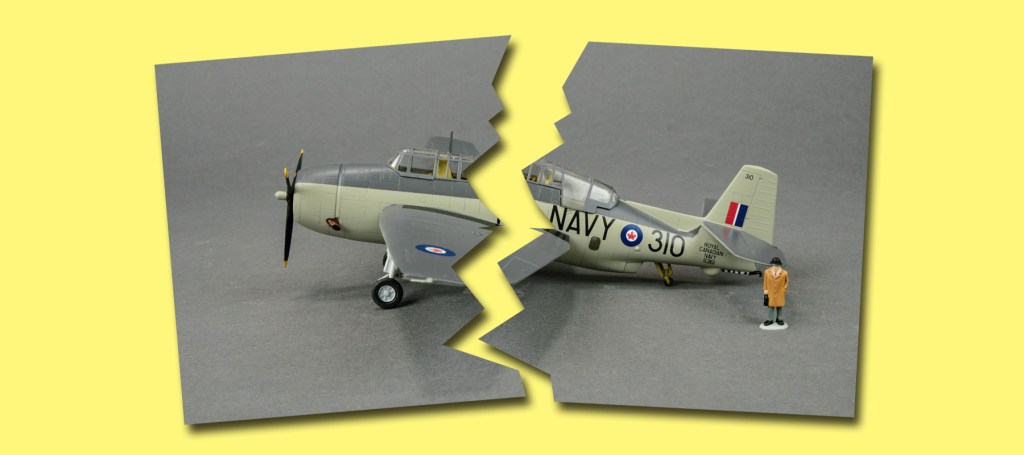
Few accidents distressed me so much when I was a child as breaking a scale model.
It happened occasionally when building, and then on during the display life of the item…we moved house frequently and you can imagine the toll this took on any collection I tried to build up. I came to appreciate Dinky and Matchbox Toys for their basic sturdiness.
These days there are fewer breakages due to house moving but accidents still occur. Just today a glass shelf shifted in an IKEA cabinet and set down on the models below it. Most were untouched, but a plastic armoured car was de-wheeled and a new Sherman tank model suffered on the topworks.
Nowadays I do not cry or cringe. I have learned the lesson of success in most ventures is effective damage control. The Japanese Navy never did figure it out.
In the case of most plastic models it is the delicate parts that break – guns, antennae, masts, etc. Pitot tubes on aircraft are particularly vulnerable.
What to do?
a. Salvage the broken bit, if at all possible.
b. Re-cement or glue it back in position. Cyanoacrylates with accelerators are the go here.They will show a mark where they are used and you need to re-touch the paint at that spot. If the part has gone forever, consult the spares box for a replacement.
c. If nothing can be found, consider a scratch-built replacement. Plastic pitot tubes can be effectively and permanently replaced with thin brass rod…you can look ahead during the building and do this in anticipation.
d. And if nothing can be found or made, consider plating off the damaged part and applying some weathering to the area. Real life damaged real life planes, tanks, and ships.
e. Likewise the repair paint job can be perfectly matched or almost matched…that is a feature of real life too. Several of my models show repaint patches that are on there deliberately.
Note that good can come from ill. The failure of the supports once on the glass IKEA shelf tell me that they will fail again. So I have made four new ones that are longer and will not let it recur. And I will check all the other glass shelves in the collection cabinets.


 The Little World
Leave a reply to Dick Stein Cancel reply