
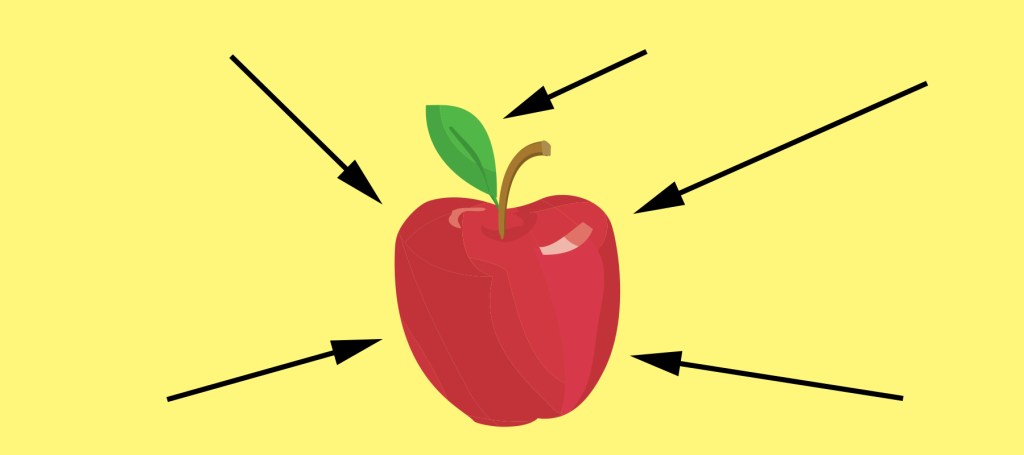
When it is drawn as a diagram on the instruction sheet of a scale model piece of fruit.
Then – particularly if the kit is from Prague – the part that looks like a Granny Smith, Mackintosh, or Cox’s Pippin could well be an aileron or de-icing strip. There will be few written notes to help you decide and if your luck is seriously out the box art will be painted from the other side of the tree.
I am a naturally cynical person but I’m glad I did not come to Czech short-run instructions until I was mature. I don’t think I could have survived in society had I read them as a youth.
I have a procedure. I look at the parts diagram and note all the obvious parts like fuselage halves and wings. They are usually easy to spot on a bright day…unless the engineering of the kit has chopped them up into weird chunks like a Chinese chicken. I pencil P and S on tailplanes and ailerons.
I used to chop the sprue tree up to reduce clutter but when you get to the teensy details you need the thing to look like the parts diagram to save confusion. Too few makers ever cut numbers into their runners.
If a part is stated to be correct number and appears on the tree and diagram as the correct part, but looks nothing like the plan, I repair to the internet and try to get some view of the real thing in a museum. Real beats a drawing any day.
The final resort is pure logic. What is the part meant to actually do and what shape would accomplish this? What would I design to do it?
 The Little World
Leave a comment