
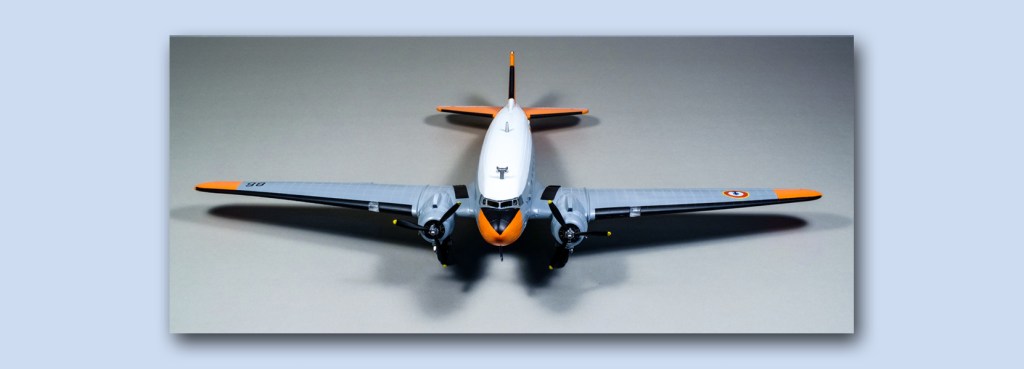
There is a lesson to be learned with this Airfix model of a DC-3 in Aéronavale colours – and I must compel myself to learn it. It is a lesson of humility.
At the start I thought this a marginal model – the sort of ugly cousin kit from an old company that had been going through ugly times – and of an ugly prototype. I do not mean that the Douglas was ugly – but what it had been reduced to in the Vietnam era was somewhat of a mess. The kit reflected this and the packaging, instructions, and decals were of a similar reduced nature. It did not even have the classic feel of a Series 2 or 3 kit of the 60’s.
The impression was not improved by seeing the discount sticker on the box lid – $ 3.95 at our local DIY hardware store… possibly tossed out to an auction house for disposal. The kit itself had languished in the roof crawl space of my friend Paul for some 40+ years…
It was an unlovely seed – and yet all it needed was some thoughtful effort and it has blossomed out into a prize.
The flaws of a kit of this sort are many – you can see the surface ones and the hidden ones I’ll gloss over. Yet the whole is far greater than the sum of the parts. The plastic is classic Airfix – slightly soft. The moulding is of the Troubled Airfix Years. There are the dreaded ” working features ” that delighted my childhood and horrify my old age. Yet the problems are all surmountable.
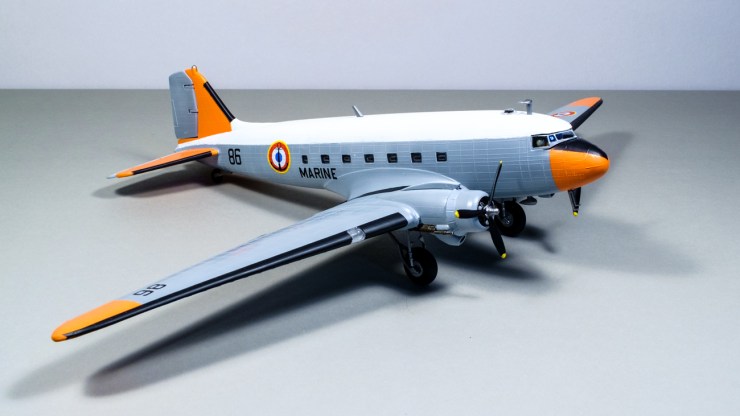
Firstly, I decided that it could not be an opened fuselage – because there was nothing but a floor in there. Any interior would have been a labour of loathe…long duplication to make seats. The condition of the doors and door surrounds was crude – so if one was not to have an open view into the thing, one had to opt for closed doors and filler in the seams.
Then the business of the wing joins – you’ve seen that these needed deep therapy.
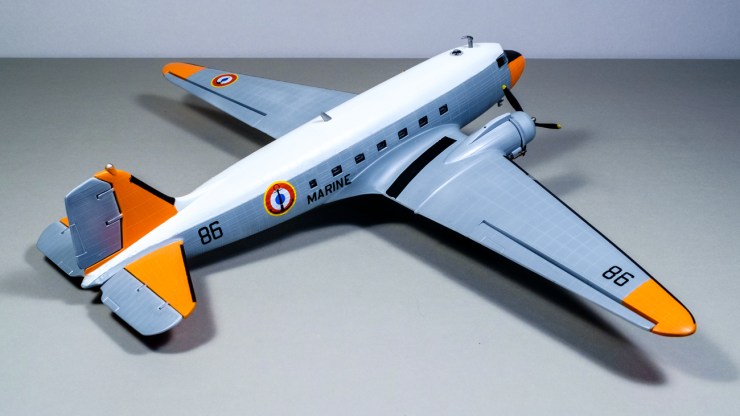
Then the raised rivets – this basically meant that complex paint or decal schemes were going to be awkward. A simple scheme was needed.
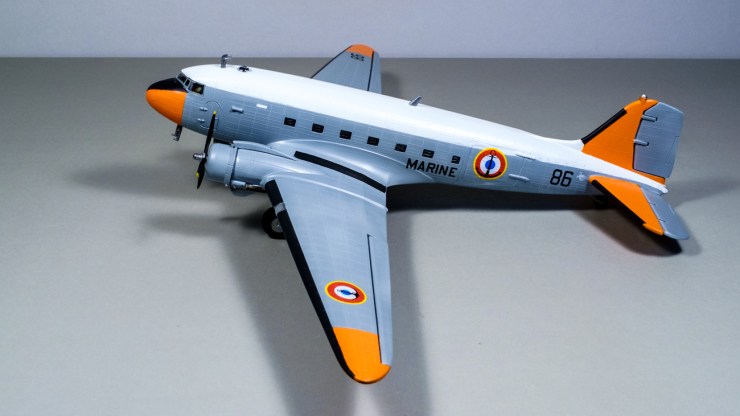
And the landing gear was fine, if a little crude. It was a playable moving part that needed to be fixed either up or down. Here is the only point at which I did not think ahead. I should have put a wooden block in as I closed the fuselage, disced the propellors, and had the aircraft on a stand in flight. I think I will do this for the next DC-3 or DC-2 copy. ( There is still a Japanese copy, a Swiss airliner, and a Soviet Lisunov in the line to build. Also an RD-4 Gooney Bird… )
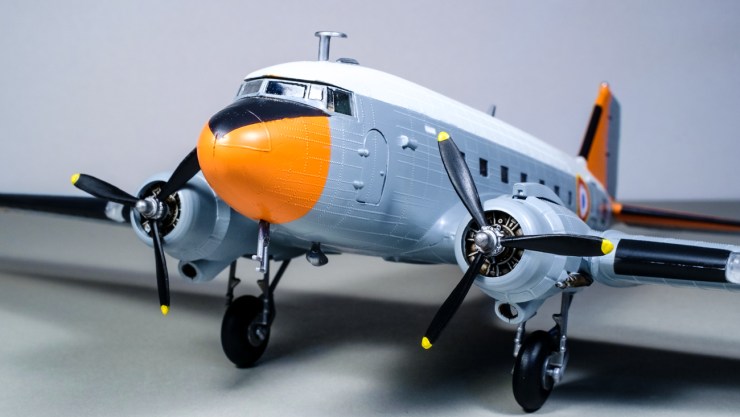
The model is not a super-detailed contest winner. It is, however a satisfying delight for the collection. It was free from a friend, but even if it had been a purchase, it is the very best kind of value for money.
Just give those old kits some love and respect, and they’ll reward you.


Leave a Reply